Case File: FAF-002
Collection: Forgotten American Files
Research Institute: NFP
Author: Douglas Estill
Published: 06/12/2026
PROLOGUE
The Word
The settlement was silent.
Not the peaceful silence of a village resting after a day’s labor, but the unsettling silence that makes a man aware of his own footsteps.
Governor John White walked slowly through what had once been England’s hope in America.
The houses were there, yet they were not.
Some had been carefully taken down. Others stood weathered by wind and rain. Grass and weeds had reclaimed paths once worn by busy feet. The sounds of children, livestock, and conversation had vanished, replaced only by the whisper of the coastal breeze moving through abandoned timber.
Three years.
Three years earlier he had sailed away believing he would soon return.
Three years earlier he had left behind men and women who trusted him.
Three years earlier he had embraced his daughter.
Somewhere in this settlement his granddaughter, Virginia Dare, the first English child born in America, had drawn her first breath.
Now there was nothing.
No welcoming voices.
No anxious faces running toward the shore.
No smoke rising from cooking fires.
Only absence.
History would one day call this place the Lost Colony.
John White did not.
To him, it was home.
He searched carefully.
Every doorway.
Every familiar corner.
He looked not as a governor inspecting a failed colony, but as a father searching for his family.
Then he saw it.
At first only three letters, carved into the bark of a tree.
CRO
He continued searching.
Soon he found the complete word, carved into one of the palisade posts surrounding the settlement.
CROATOAN
For more than four centuries, historians have treated that single word as one of America’s greatest mysteries.
Perhaps it was.
But to John White, it may have meant something entirely different.
Before leaving Roanoke, he and the settlers had agreed upon a simple plan.
If circumstances forced them to relocate, they would carve the name of their destination.
If they departed under distress, they would add a cross.
White found no cross.
Only a destination.
For one brief moment, hope may have returned.
Perhaps his daughter still lived.
Perhaps his granddaughter still lived.
Perhaps they had done exactly what practical people would do when survival demanded difficult choices.
Perhaps they were waiting.
He pleaded to continue the search.
History, however, is often governed not by hope but by circumstance.
Storms gathered.
Anchors were lost.
The ship that had carried him across the Atlantic could not safely continue.
The decision was made.
The sails were raised.
The coastline slowly disappeared into the distance.
John White never saw his family again.
For generations, the world has asked:
What happened to the Lost Colony of Roanoke?
This investigation begins with a different question.
What happened to the people?
To answer that question, we must return to a time before there was a mystery.
Before there was a carved word.
Before there was silence.
We must go back to England, where ordinary families stood upon a dock believing they were sailing not into history, but into tomorrow.
To the Reader
History remembers them as The Lost Colony.
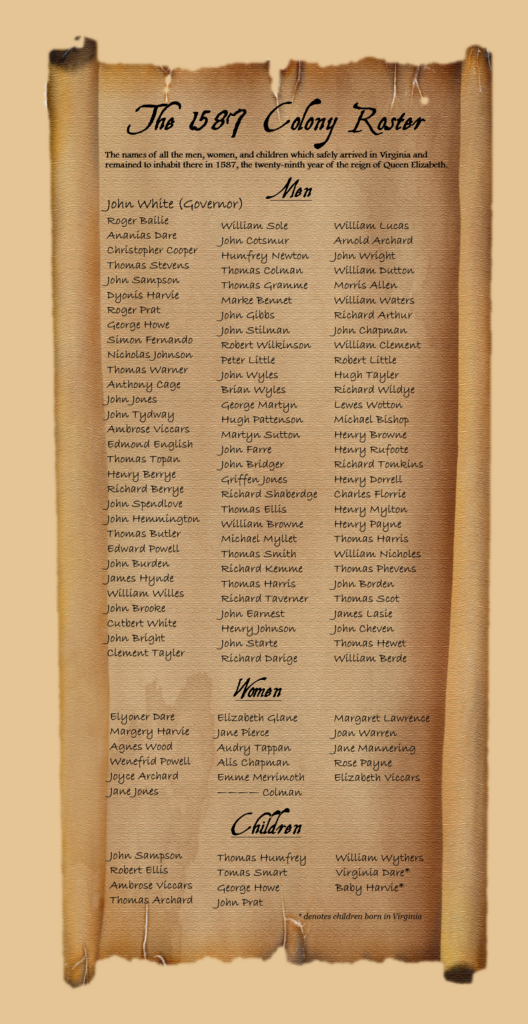
One hundred and seventeen people.
A number.
A statistic.
A mystery.
For more than four centuries, those three words have become part of the American imagination. Schoolchildren learn that a colony disappeared. Scholars debate theories. Archaeologists search for artifacts. Writers propose explanations. Generation after generation has attempted to solve the mystery.
Yet in all those years, something remarkable has happened.
The mystery survived.
The people did not.
History reduced them to a number.
But numbers do not laugh.
Numbers do not worry.
Numbers do not kiss their children goodbye before boarding a ship.
Numbers do not stand on a lonely shore wondering whether a father will ever return.
People do.
These one hundred and seventeen souls were not characters in a legend. They were husbands and wives, mothers and fathers, craftsmen and laborers, servants and children. They carried fears that history never recorded and hopes that history seldom considered. They crossed an ocean believing that tomorrow might offer what yesterday could not.
Most never imagined that strangers would one day remember only that they had disappeared.
They had names.
Some were old enough to understand the risks before them.
Some were young enough to believe that every journey was an adventure.
One child, Virginia Dare, would become famous simply because history remembered her birth and forgot her life.
The others deserve no less remembrance.
The pages that follow are not written to prove a theory or to force a conclusion. Whenever the evidence speaks, we will listen. Whenever the evidence is uncertain, we will say so. Whenever we speculate, we will identify it as speculation.
But before we investigate what became of these people, we owe them a greater courtesy.
We must first meet them.
For the greatest tragedy of the Lost Colony may not be that history lost track of one hundred and seventeen settlers.
It may be that history stopped seeing them as human beings.
If, when you finish this work, you remember only one thing, let it be this:
They were never simply The Lost Colony.
They were people.
And every one of them answered to a name.
Chapter I
Dreams Across the Atlantic
There are moments in history when the future appears so certain that no one imagines how completely fate is about to intervene.
The year was 1587.
England stood at the edge of possibility. Beyond the Atlantic Ocean lay a continent that few English men and women had ever seen but many had begun to imagine. Reports from earlier expeditions spoke of vast forests, broad rivers, fertile lands, and opportunities unknown in the crowded towns and villages of home.
To statesmen, America represented empire.
To merchants, it represented commerce.
But to ordinary families, it represented something far simpler.
A chance.
History has a habit of remembering kings, admirals, and governors while overlooking the people whose lives gave meaning to great events. The Lost Colony was not composed of legends. It was composed of human beings.
There were farmers who understood the seasons better than politics. Carpenters whose greatest ambition was to build homes that would shelter generations yet unborn. Blacksmiths whose hands had shaped iron since boyhood. Women who gathered together the few possessions that could fit aboard a crowded ship while quietly deciding which cherished belongings must be left behind forever.
Children, perhaps the bravest of them all, accepted the journey without understanding its dangers. They trusted the adults around them, believing that wherever Mother and Father went must surely be the safest place in the world.
Every family carried private hopes that history would never record.
Some dreamed of owning land.
Some dreamed of escaping poverty.
Some dreamed simply of giving their children opportunities that England could not provide.
Those dreams never appeared in official reports.
Yet they were the true cargo of the expedition.
Among those preparing for the voyage stood Governor John White.
History would remember him as the leader of the colony.
His family knew him by another name.
Father.
His daughter, Eleanor Dare, would accompany the expedition with her husband, Ananias Dare. Before long, they would welcome a daughter of their own, Virginia Dare.
Generations of Americans would know that child’s name.
To John White, she was simply his granddaughter.
Nothing in the surviving record suggests that White imagined his family would become part of one of history’s greatest mysteries. Like the others, he believed they were traveling toward a future that could be built through determination and hard work.
The destination had already been chosen.
The settlers were to establish a permanent English colony in the Chesapeake Bay, a location believed to offer protected waters, fertile land, and the best opportunity for lasting success. Months of planning rested upon that decision. Maps had been studied. Reports had been evaluated. Expectations had been formed.
The future seemed organized.
How often history has smiled at human plans.
The morning of departure must have been filled with emotions familiar to every generation that has ever left home.
Parents embraced children.
Friends promised to meet again.
Some wept openly.
Others concealed their fears behind confidence.
Every departing ship carries two kinds of passengers: those aboard and those left standing on the shore.
As the vessels finally caught the wind and moved away from England, familiar landmarks slowly disappeared into the distance.
Behind them lay certainty.
Ahead lay possibility.
The Atlantic became their world.
Days blended into weeks. The endless movement of the sea created its own rhythm of labor and expectation. Storms came and passed. Calm waters returned. Conversations inevitably turned toward America.
Where would the first houses stand?
How much land might each family cultivate?
Would children born there think of England as home, or would they become something entirely new?
No journal preserves those conversations.
It does not need to.
Every immigrant generation has asked the same questions.
The settlers believed they knew where they were going.
They did not.
For somewhere aboard those ships, unnoticed by the men and women who gazed hopefully toward the western horizon, history had already begun preparing a single decision that would alter every plan they had made.
The greatest mystery in early American history did not begin with a carved word.
It began with hope.
And hope, history reminds us, is often strongest in the moments just before it is tested.
Chapter II
The Wrong Shore
For weeks the Atlantic Ocean had been both companion and adversary.
Its endless horizon became the measure of time itself. Days were marked not by church bells or village clocks, but by the rising and setting of the sun and the shifting direction of the wind. The sea offered no certainty except that England grew farther away with every passing mile.
Yet hope remained remarkably resilient.
Each morning carried the possibility that land might finally appear.
Then one day, it did.
The cry would have traveled quickly through the ships.
“Land!”
No surviving account tells us exactly what the settlers felt in that moment. History rarely preserves such details. But human nature has changed little through the centuries. Mothers gathered children to see the distant shoreline. Men strained their eyes toward forests and beaches they had imagined for months. Conversations that had lived only in dreams suddenly seemed within reach.
At last, America.
For many aboard, this was the reward for every sacrifice already made. England now belonged to memory. Before them lay the place where homes would be built, fields would be planted, and families would establish a new beginning.
They believed they knew where they were going.
The Chesapeake Bay.
That destination had not been chosen casually. It represented months of planning and deliberation. Reports suggested protected waters and greater opportunities for a permanent settlement. The colonists had organized their expectations around that decision.
History, however, is under no obligation to respect human plans.
Somewhere between expectation and reality stood a navigator named Simon Fernandez.
Exactly why Fernandez refused to carry the settlers farther remains a matter historians continue to debate. The surviving evidence allows us to know the outcome more clearly than the motive. Whether impatience, professional judgment, personal interest, or circumstances now lost to history influenced his decision cannot be stated with certainty.
The result, however, is beyond dispute.
The voyage ended at Roanoke.
To later generations studying maps, the difference between Roanoke and the Chesapeake may appear only a matter of geography.
To the settlers, it meant something entirely different.
Every conversation they had shared during the Atlantic crossing had assumed another destination.
Every hope had been attached to another place.
Every expectation suddenly required revision.
One can almost imagine the confusion.
Surely there had been some misunderstanding.
Surely the ships would continue north once supplies were organized.
Surely this was only a temporary stop.
But gradually reality asserted itself.
This was where they would remain.
The boats moved back and forth between ship and shore. Chests were unloaded. Tools were carried onto unfamiliar ground. Livestock and provisions followed. With every trip, the possibility of continuing the voyage grew smaller.
Until finally, there was no voyage left to continue.
The settlers stood upon Roanoke Island.
Behind them stretched an ocean that had cost them everything familiar.
Before them stood a future they had never intended to build.
Modern history often searches for the precise moment when the Lost Colony’s mystery began.
Perhaps it began here.
Not with violence.
Not with starvation.
Not with disappearance.
But with a simple decision that transformed carefully laid plans into uncertain improvisation.
History sometimes changes because of kings and battles.
Sometimes it changes because ordinary people are asked to make extraordinary lives in a place they never meant to call home.
The families gathered their belongings.
The carpenter still possessed his tools.
The farmer still possessed his knowledge.
The blacksmith still possessed his skill.
The mothers still possessed their courage.
What they no longer possessed was the future they had imagined while crossing the Atlantic.
So they did what ordinary people have always done when history refuses to cooperate.
They unpacked.
They went to work.
And without realizing it, they stepped into one of the greatest mysteries in American history.
They had crossed an ocean…
and arrived at the wrong future.
Chapter III
The Last Goodbye
There are moments in history that seem ordinary when they occur, only to become extraordinary because of what follows.
John White’s departure from Roanoke was one of those moments.
To later generations, it would become a defining event in the mystery of the Lost Colony. To the settlers gathered on that lonely shore, however, it was something much simpler.
Someone had to go back to England.
The decision was born not of ambition but of necessity.
The colony had not been established where it was intended. Supplies were limited. Tools would eventually fail. Powder would be consumed. Seed for future harvests would be exhausted. However determined the settlers might be, determination alone could not feed a community.
If the colony was to survive, England had to know its circumstances.
Someone had to sail.
John White accepted the responsibility.
History often presents his departure as an administrative necessity, the logical action of a governor reporting to those who financed the enterprise.
That is true.
It is also incomplete.
He was not merely leaving a colony.
He was leaving his family.
His daughter, Eleanor Dare, remained behind.
So did her husband, Ananias Dare.
Somewhere within the settlement was his infant granddaughter, Virginia Dare, whose birth had filled the colony with hope only days before.
No document records their farewell.
No eyewitness preserved the words they spoke.
Perhaps that silence is fitting.
The deepest moments of human life are often the least recorded by history.
One can say only what the evidence allows.
John White expected to return quickly.
The settlers expected him to return.
No one standing on the shores of Roanoke believed that this would be their final goodbye.
The boats carried him back to the waiting ships.
The anchors were raised.
Sails filled with wind.
Slowly, almost imperceptibly, the distance between father and daughter began to grow.
Those remaining on shore could do nothing but watch.
Those aboard could do nothing but look back.
Every passing mile was understood as temporary.
Every promise rested upon the assumption that England would respond swiftly.
The sea gradually erased the shoreline from view.
Life on Roanoke, however, could not pause while waiting.
The carpenter still had work before him.
The blacksmith still had iron to shape.
The farmer still searched for ground that would sustain a harvest.
Children still laughed, because children have an extraordinary gift for living in the present while adults carry the burdens of tomorrow.
As days became weeks, the colony settled into the difficult rhythm of frontier life.
Every sunrise brought labor.
Every sunset brought fatigue.
And somewhere beyond the eastern horizon, Governor John White sailed toward England carrying not merely the hopes of a colony but the expectations of a family waiting for his return.
He believed he was leaving for a few months.
History had already decided otherwise.
Across Europe, forces entirely beyond the control of the settlers were beginning to reshape the world they had left behind. England’s growing conflict with Spain would soon consume ships, men, and resources. The voyage that White imagined as a temporary absence would become impossible to repeat.
But Roanoke knew none of this.
The colony possessed no messenger faster than the wind.
No letters could cross the Atlantic.
No warning could tell Eleanor Dare why her father did not return.
From her perspective, the horizon remained empty.
The passing of time would become the colony’s greatest enemy.
For centuries, historians have asked why John White left Roanoke.
The better question may be why he believed he could.
Like every father who kisses his family goodbye before setting out on a necessary journey, he expected the separation to be brief.
He could not know that fate would transform a temporary farewell into a lifetime of uncertainty.
And so the ships disappeared beyond the horizon.
The people on shore returned to their work.
The people at sea returned to their duties.
Both believed they would soon see one another again.
Neither knew that history had just written one of the saddest chapters in early America.
Chapter IV
Waiting for Sails
There are many ways to measure time.
Kings measure it by reigns.
Nations measure it by wars.
Historians measure it by dates.
Families measure it differently.
They measure it by waiting.
When Governor John White sailed from Roanoke, the settlement did not descend immediately into crisis. Life, stubborn and practical, continued much as it always had. The sun still rose over the Atlantic each morning. The forests still demanded labor. The waters still yielded fish to those willing to seek them.
The colony had no choice but to continue living.
Every day required work.
Shelters needed repair.
Wood had to be gathered.
Food had to be found.
Children had to be cared for.
The frontier possessed little sympathy for uncertainty.
At first, optimism probably remained strong.
Ships crossed oceans slowly. Storms delayed voyages. Winds determined schedules more than calendars. No reasonable person would have expected John White to return within weeks.
There was still time.
The settlers understood patience.
Then weeks became months.
The colony adjusted its expectations.
Perhaps they told themselves that England was gathering supplies.
Perhaps they imagined additional settlers preparing to join them.
Perhaps every morning someone climbed to a place where the sea could be seen and searched the eastern horizon for sails.
History does not record such moments.
Human nature does.
Anyone who has ever waited for the return of someone they love understands the quiet rituals of hope.
You look once.
Then twice.
Then one final time before turning away.
Tomorrow, you tell yourself, may be different.
Tomorrow becomes another yesterday.
The people of Roanoke knew nothing of the great events unfolding across the Atlantic.
They could not know that England’s growing conflict with Spain was consuming ships and men.
They could not know that resources once intended for colonization were now needed for national defense.
They could not know that the voyage they expected within months would become impossible.
The Atlantic Ocean carried no newspapers.
Its winds brought no explanations.
Silence became the colony’s only messenger.
Meanwhile, life itself continued to move forward.
Children grew.
Tools wore out.
Supplies diminished.
The seasons obeyed their own laws, indifferent to English expectations.
The greatest danger facing the colony was no longer isolation.
It was uncertainty.
Every additional day without news transformed hope into calculation.
How long should they wait?
Could another harvest sustain them?
Could another winter?
Communities are sustained by courage, but they survive through judgment.
The people of Roanoke had not crossed an ocean because they lacked initiative. Their very presence in America testified to remarkable determination. They had already abandoned certainty once in pursuit of a better future.
Would they now refuse to act while waiting for rescue that might never come?
Modern readers often imagine history as a sequence of dramatic decisions.
Real history usually changes quietly.
A conversation after supper.
An inventory of dwindling provisions.
A glance exchanged between neighbors who already know the answer before anyone speaks.
No surviving document tells us when the first person asked the question.
But eventually someone must have.
“What if Governor White does not return?”
The words themselves were probably painful.
The implication was unavoidable.
The colony could not survive forever on expectation alone.
For generations, historians have wondered when the Lost Colony disappeared.
Perhaps that is the wrong way to think about it.
Colonies do not simply disappear.
People make decisions.
Parents choose life for their children.
Communities adapt.
The question was never whether the settlers possessed courage.
The question was whether they possessed the wisdom to recognize that waiting, however hopeful, could not become a permanent strategy.
Somewhere, perhaps around a rough wooden table or beside a dying evening fire, the people of Roanoke may have begun discussing not how to wait…
but how to live.
And in that quiet change of thought, unnoticed by history, the greatest mystery in early America may already have begun.
Chapter V
The Decision to Live
History has asked the wrong question.
For more than four centuries, scholars have debated where the colonists went. Maps have been studied, artifacts unearthed, and theories proposed. Entire libraries have been devoted to answering the mystery.
Yet before asking where they went, we must first ask something far more fundamental.
What would ordinary human beings do if survival were their only objective?
The answer to that question is not found in legend.
It is found in anthropology.
It is found in human nature.
Throughout history, communities facing isolation and dwindling resources have behaved in remarkably similar ways. They do not deliberately choose extinction in order to preserve a plan. They adapt. They negotiate. They relocate. They seek alliances. Above all, they protect their children.
The people at Roanoke were no different.
By now they had waited through changing seasons. Every day that passed without the return of John White forced reality to replace optimism. Hope remained, but hope could no longer fill empty storehouses or guarantee another harvest.
Practical minds would inevitably begin asking practical questions.
How much food remains?
Can the land sustain us?
Can this settlement support another year?
What alternatives exist?
These are not the questions of desperate people.
They are the questions of responsible people.
The modern imagination often pictures the colonists as isolated Englishmen determined to preserve their identity at all costs.
History suggests a different possibility.
The frontier rewards flexibility.
Those who survive are often those most willing to learn from the people who already understand the land.
To the south lay Croatoan, home to Native people known to the English and generally regarded as friendly. They understood the waters, the fisheries, the seasons, and the resources of the Outer Banks in ways the newcomers could not yet comprehend.
For a community seeking survival, this was not merely geography.
It was opportunity.
Some historians have imagined the colonists scattering in every direction, dissolving into the wilderness almost overnight.
Such a scenario is possible.
It is also contrary to the way human communities usually behave.
When danger increases, families tend to gather rather than separate.
Mothers do not voluntarily increase the distance between themselves and their children.
Neighbors who have crossed an ocean together seldom abandon one another at the first sign of hardship.
The strength of a community lies in its numbers.
That simple observation may alter the entire mystery.
Suppose, instead, that the settlers remained together.
Suppose they followed the contingency they had already discussed with John White—that if relocation became necessary, they would leave their destination carved for him to find.
Suppose they chose Croatoan not as a final destination, but as a refuge.
Everything begins to look different.
The carved word later discovered by John White ceases to be a cryptic message.
It becomes an address.
The move itself would not have solved every problem.
Croatoan was no magical paradise.
Its environment differed significantly from the agricultural traditions the English settlers knew. Fishing and local resources could sustain life, but families accustomed to English farming might eventually seek more productive land elsewhere.
And there, perhaps, lies the beginning of the next chapter.
Communities do not remain frozen in time.
Children grow.
Marriages occur.
Friendships become alliances.
New opportunities emerge.
What begins as one settlement may gradually become several.
Not because people are lost.
Because people live.
Perhaps the greatest error in the study of Roanoke has been to imagine disappearance where history may instead have witnessed transformation.
A colony may vanish from English records while continuing to exist in human lives.
Parents still wake before dawn.
Children still laugh.
Meals are still shared.
The language may change.
The customs may change.
Even the identity of the community may change.
But life goes on.
History has spent centuries searching for the moment when the colonists disappeared.
Our investigation suggests another possibility.
Perhaps there never was such a moment.
Perhaps there was only a series of ordinary decisions made by ordinary people who refused to die.
If that is true, then the greatest mystery of Roanoke is not how a colony vanished.
It is how generations of historians came to mistake survival for disappearance.
Chapter VI
Life Goes On
History has an unfortunate habit.
It remembers catastrophes.
It often forgets ordinary Tuesdays.
When people read about Roanoke, they imagine a single dramatic event—a massacre, an attack, or a sudden disappearance occurring in one terrible moment.
Real human communities rarely behave that way.
Life continues.
Morning follows night.
Children wake hungry.
Parents go to work.
The elderly tell stories while the young make plans.
The great mystery of Roanoke may have been created because later generations expected history to move dramatically when, in reality, it probably moved quietly.
Imagine a family that has survived another season.
The immediate crisis has passed.
Food has been found.
Shelter has been secured.
The community has adapted to circumstances it never expected.
Human beings possess an extraordinary ability to transform necessity into routine.
Yesterday’s emergency becomes today’s normal life.
The settlers who had once measured their days by England now measured them by America.
The tides became familiar.
The forests became familiar.
The people around them became familiar.
The unknown slowly became home.
This transformation did not require anyone to abandon their identity.
It required them to expand it.
The frontier teaches lessons that no classroom can provide.
Knowledge is exchanged.
Skills are shared.
Friendships emerge from cooperation.
Children learn more quickly than adults.
They always have.
A child who plays with another child does not ask the questions that trouble historians centuries later.
Children ask only,
“Will you play with me?”
Communities evolve through thousands of such ordinary moments.
History seldom records them because they appear insignificant.
Anthropologists understand that they are everything.
Meanwhile, another reality quietly asserted itself.
The English settlers had crossed an ocean carrying agricultural traditions developed over generations in a different environment. The land before them demanded adaptation.
Fishing might supplement the table.
Hunting might provide meat.
Trade might replace isolation.
Every successful decision encouraged another.
Every season survived created confidence that the next could also be survived.
Time itself became an ally.
Modern readers often imagine that assimilation happens through dramatic events.
It usually happens through birthdays.
Harvests.
Friendships.
Marriages.
Shared dangers.
Shared victories.
Shared grief.
Years change people more profoundly than single moments ever can.
If some members of the community eventually sought more productive farmland or stronger alliances elsewhere, such decisions would not represent the collapse of a colony.
They would represent the ordinary movement of human beings pursuing opportunity.
Families relocate.
Communities divide.
New settlements emerge.
This has happened throughout history on every inhabited continent.
To later observers examining scattered evidence centuries afterward, these movements may appear mysterious.
To the people living them, they would have appeared entirely practical.
Perhaps the greatest mistake in studying Roanoke has been assuming that its story ended.
Human stories rarely end.
They continue until another generation tells them differently.
And somewhere across the Atlantic, entirely unaware of the quiet transformations occurring in America, a father named John White was still trying to come home.
He believed that he was racing against distance.
He did not yet understand that his greatest adversary was time.
While he struggled to reach his family…
his family was struggling to build a future without him.
History would eventually bring them within sight of one another again.
But first, it would separate them by three years, an ocean, and one of the cruelest twists of fate in early American history.
Chapter VII
The Long Voyage Home
There are two kinds of distance.
One is measured in miles.
The other is measured in circumstances beyond human control.
John White would come to know both.
When he departed Roanoke, he carried with him more than reports for the investors in England. He carried the expectations of an entire settlement. More personally, he carried a promise silently understood between himself and those he loved.
He would return.
Nothing in the surviving record suggests that he intended otherwise.
Indeed, every decision he made after reaching England demonstrates a determination to organize relief for the struggling colony. The problem was never willingness.
The problem was history.
While the settlers measured time by empty horizons and changing seasons, England measured it by an entirely different clock.
The nation stood upon the brink of conflict with Spain. Resources that might have sustained colonization were redirected toward survival. Ships became instruments of national defense. Sailors became soldiers. The Atlantic itself, once merely a difficult crossing, became part of a larger struggle between kingdoms.
John White found himself trapped by events he neither created nor controlled.
Days became weeks.
Weeks became months.
Months became years.
To later generations reading history, those words pass quickly across the page.
To a father waiting to return to his daughter and infant granddaughter, they must have passed with agonizing slowness.
One imagines the conversations repeated countless times.
“When can we sail?”
“Soon.”
“When will ships be available?”
“When circumstances permit.”
Hope, once measured in weeks, learned to survive on uncertainty.
It is one of history’s cruelest ironies that the man later accused by some of abandoning the colony spent those very years trying to reach it.
Eventually, an opportunity appeared.
But even here, fate refused simplicity.
John White did not command a great rescue expedition assembled solely for the purpose of recovering the settlers. He secured passage with a privateering venture whose principal interests lay elsewhere. The captains and crews sought Spanish prizes and commercial advantage. White’s desperate mission existed alongside objectives that many aboard considered more important.
His family depended upon men whose priorities were not his own.
Nevertheless, he sailed.
One can scarcely imagine the emotions that accompanied that departure.
Every favorable wind shortened the distance separating him from his daughter.
Every mile carried him closer to Virginia Dare, who by now would no longer be the infant he had left behind.
Children do not wait for history.
They grow.
Perhaps she had begun to speak.
Perhaps she had learned to walk.
Perhaps she asked questions about the grandfather who had sailed away.
History cannot answer.
It can only remind us that time changes children while adults are occupied elsewhere.
The Atlantic crossing that had once carried hope now carried urgency.
John White was no longer traveling toward a dream.
He was traveling toward a promise.
Meanwhile, unknown to him, life in America had continued.
The people he sought were making decisions of their own.
Seasons had come and gone.
Children had grown.
Communities had adapted.
The colony he remembered no longer existed in exactly the form he had left it.
Neither did the world.
And so, after three years of frustration, disappointment, and determination, John White once again approached the coast of America.
He believed he was nearing the end of his journey.
History knew he was approaching its most heartbreaking chapter.
Sometimes tragedy is not created by hatred.
Sometimes it is created by timing.
A father finally returns.
A family has already moved.
Between them stands only distance.
And fate has not yet finished its work.
Chapter VIII
One Word
Sometimes history whispers.
The world expects thunder, battles, and proclamations that change nations. Instead, the greatest turning points are often found in silence.
John White stepped ashore.
For three years he had imagined this moment.
He had crossed an ocean carrying disappointment, frustration, and hope in equal measure. Every obstacle overcome had strengthened one belief: that somewhere ahead waited the people he loved.
The shoreline looked familiar.
The settlement did not.
Something was wrong.
At first it may have been difficult to define. The structures still stood, yet they no longer possessed the character of a living community. The ordinary sounds that give life to a settlement were absent.
No voices.
No barking dogs.
No children running to greet strangers.
Only wind.
White walked slowly through the colony he had left behind.
He was not conducting an official inspection.
He was searching.
Every empty doorway represented another unanswered question.
Every abandoned corner invited another hope that someone might suddenly appear.
No one did.
History has often described this moment by emphasizing what White failed to find.
No bodies.
No signs of battle.
No evidence of sudden destruction.
Yet perhaps we should pay greater attention to what he did find.
The settlement had not been abandoned in panic.
Buildings had been carefully dismantled rather than violently destroyed. Property had not been scattered in haste. The scene suggested movement rather than catastrophe.
Then he noticed the carving.
Three letters first.
CRO
He continued searching until he discovered the complete inscription.
CROATOAN
No other single word in early American history has inspired more speculation.
For generations it became a riddle.
For John White, it may have been something entirely different.
Before leaving Roanoke, he and the settlers had established an understanding. Should they relocate voluntarily, they would leave the name of their destination carved where he could find it. If they departed under distress, an additional sign would warn him.
He found no such warning.
Only one word.
Modern readers often encounter that word already knowing its fame.
John White did not.
He encountered it as a father.
For one brief moment, despair may have yielded to hope.
If the agreement had been honored, then the message was clear.
They had moved.
And he knew where.
The distance separating Roanoke from Croatoan was measured not in an ocean, but in coastal waters already familiar to experienced mariners.
His family might still be alive.
His daughter.
His son-in-law.
His granddaughter.
Perhaps they had done exactly what practical people should do when survival demanded adaptation.
Perhaps they were waiting.
History has spent centuries asking whether the carving solved the mystery.
Perhaps to John White it solved it immediately.
The mystery, from his perspective, may never have been where they went.
The mystery was whether he could reach them.
The answer, cruelly, still lay ahead.
For the first time in three years, John White stood closer to his family than he had since sailing from Roanoke.
He could not know that history would permit him to come this far—
and no farther.
Sometimes tragedy does not announce itself.
Sometimes it is carved into wood.
In a single word.
And in that word lived the last hope of a father who believed he was about to find his family.
Chapter IX
The Evidence Speaks
There comes a moment in every investigation when the researcher must set aside opinion and examine only the evidence.
That moment has now arrived.
For several chapters we have walked beside the settlers. We have crossed the Atlantic with them, stood upon the wrong shore, watched a father sail away, endured years of waiting, and returned with John White to an abandoned settlement.
Emotion has accompanied us.
It must not govern us.
Our responsibility now is to ask a simple question:
What does the evidence actually tell us?
The evidence tells us that before Governor John White departed, an agreement existed between him and the settlers.
Should they relocate, they would leave the name of their destination.
Should they leave under distress, they would add a cross.
When White returned, he found one word.
CROATOAN.
He did not report finding the agreed-upon sign of distress.
That fact deserves careful consideration.
The evidence also tells us that White found no convincing indication of sudden destruction. The settlement had not simply been reduced to chaos. Structures had been dismantled with purpose rather than abandoned in panic. The scene suggested movement rather than catastrophe.
Again, the evidence deserves careful consideration.
What the evidence does not tell us is equally important.
It does not tell us that every settler moved together.
It does not tell us that every settler remained at Croatoan.
It does not tell us that every settler assimilated into a Native community.
It does not tell us that every settler died.
History often invites certainty where none exists.
Good investigation resists that temptation.
Anthropology, however, allows us to ask another question.
When isolated human communities confront uncertainty, hunger, and changing circumstances, what do they generally do?
The answer, observed across cultures and centuries, is remarkably consistent.
They adapt.
They seek alliances.
They relocate when necessary.
They divide when opportunity requires.
They preserve the next generation.
Such observations do not prove what happened at Roanoke.
They simply remind us that the colonists were human beings, and human beings usually choose survival over symbolism.
From England’s perspective, the disappearance of an English settlement represented failure.
From the perspective of a mother trying to feed her children, success was measured differently.
History has long searched for the place where the colony vanished.
Perhaps investigators should instead search for the places where its people continued to live.
This possibility does not solve the mystery.
It does something more important.
It changes the question.
Instead of asking,
“Why did they disappear?”
we may ask,
“How did they survive?”
The difference between those two questions is profound.
One assumes an ending.
The other allows for a continuation.
As journalists, we cannot declare what the evidence does not establish.
As anthropologists, we cannot ignore what human behavior consistently demonstrates.
Therefore, we arrive at a conclusion that is both cautious and compelling.
The available evidence is consistent with the possibility that the settlers made rational decisions intended to preserve life.
Whether those decisions ultimately led to Croatoan alone, to additional settlements inland, or to gradual assimilation with neighboring Native communities remains an open question deserving continued investigation.
The mystery of Roanoke may never be fully solved.
But perhaps history has committed a different error.
Perhaps it has mistaken adaptation for disappearance.
And if so, then for more than four centuries we have searched for a colony…
when we should have been searching for people.
Epilogue
A Different Verdict
For more than four centuries, history has rendered its judgment.
It called them
The Lost Colony.
Those three words became accepted so completely that few paused to ask whether they accurately described the people to whom they referred.
A colony may indeed have been lost.
But were the people?
That question deserves careful consideration.
The evidence establishes certain facts.
Governor John White returned to Roanoke in 1590.
He found the settlement abandoned.
He discovered the word CROATOAN carved where it could be seen.
He found no agreed-upon sign indicating that the colonists had departed under distress.
He wished to continue his search.
Circumstances prevented him from doing so.
Those facts belong to history.
Beyond them lies investigation.
The archaeological record continues to evolve.
Historical documents continue to be examined.
Scholars continue to debate competing interpretations.
Reasonable people may differ.
They should.
That is the nature of honest scholarship.
Yet there is another form of evidence that deserves attention.
It is the evidence of humanity.
Throughout history, isolated communities confronted with uncertainty have demonstrated remarkable resilience. They relocate. They adapt. They establish new relationships. They modify old customs to meet new realities.
Most importantly, they strive to preserve the next generation.
Nothing in the surviving evidence requires us to believe that the settlers chose extinction when alternatives may have existed.
Nor does the surviving evidence permit us to declare with certainty exactly what became of them.
The responsible investigator must therefore accept both possibilities at once:
Humility before the evidence.
Confidence in human resilience.
Perhaps future discoveries will answer questions that today remain unresolved.
Perhaps they will not.
But there is one conclusion that requires no speculation.
The men, women, and children who sailed from England were not abstractions.
They were people.
They loved.
They worried.
They sacrificed.
They hoped.
History has often remembered them only for their disappearance.
This investigation has attempted something different.
It has sought to remember them for their humanity.
Perhaps that is the proper legacy of the Roanoke settlers.
Not that they vanished.
But that, when confronted with circumstances beyond their control, they likely did what human beings have always done.
They tried to live.
And if they succeeded, even for another season, another year, or another generation, then their story is not merely one of mystery.
It is one of courage.
The final verdict, therefore, does not belong to this author.
It belongs to the reader.
Examine the evidence.
Consider the possibilities.
Follow the facts wherever they lead.
But before closing these pages, remember one thing.
History called them The Lost Colony.
They never called themselves that.
They were fathers walking beside sons.
Mothers carrying daughters.
Neighbors helping neighbors.
Families trying to build tomorrow.
And perhaps, somewhere beyond the reach of English records but not beyond the reach of history, they accomplished the very thing that had brought them across the Atlantic in the first place.
They survived.
They Had Names