Chapter Two
Arthur Barlowe’s New World
The Voyage That Introduced England to Virginia — 1584
“The first Englishman to describe the land that would become Virginia did not begin with a map. He began with a scent carried upon the wind.”
Before England established a fort, appointed a colonial governor, or sent families across the Atlantic, Sir Walter Raleigh needed answers.
Where could English ships anchor safely?
Was the land suitable for farming?
What resources could be found there?
Who governed the country?
Could peaceful relations be established with the Native peoples who already inhabited it?
In the spring of 1584, Raleigh entrusted those questions to two experienced sea captains, Philip Amadas and Arthur Barlowe.
Their voyage would become the opening act of the Roanoke story.
A Mission of Observation
Amadas and Barlowe were explorers—not colonists.
No families accompanied them. They carried no plans to construct houses, raise defensive walls, or establish a permanent settlement. Their assignment was reconnaissance.
They were to cross the Atlantic, examine the coast of North America, gather reliable information, and return to England with an honest assessment of the country Raleigh hoped to claim.
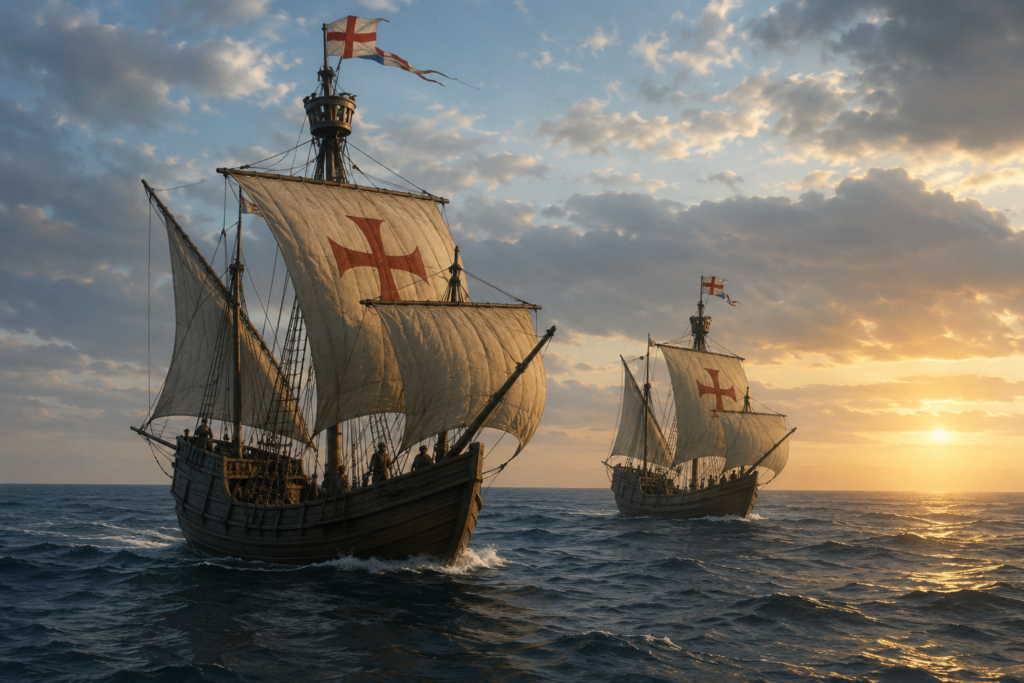
Arthur Barlowe’s account of that voyage survives as one of the earliest English eyewitness descriptions of the region that would soon be called Virginia.
He began his narrative simply:
“The 27 day of April, in the yeere of our redemption, 1584, we departed the west of England with two Barkes…”
The two vessels sailed southward toward the Canary Islands before crossing the Atlantic by way of the West Indies—a route familiar to experienced sixteenth-century navigators.
After weeks at sea, the sailors encountered their first sign that land was near.
They did not see it.
They smelled it.
The New World Announced Itself
Long before the coastline appeared upon the horizon, a strong fragrance reached the ships from somewhere beyond their sight.
Barlowe remembered:
“…we smelled so sweet, and so strong a smell, as if we had bene in the midst of some delicate garden…”
It remains one of the most memorable passages in the literature of early English exploration.
The country announced itself not through a line drawn upon a map, but through a scent carried across the water by a summer wind.
Soon afterward, the coastline appeared.
The expedition searched for an entrance through the dangerous barrier islands and shallow waters protecting the sounds beyond them. After reaching land, the English formally claimed the country in the name of Queen Elizabeth I and under the authority granted to Sir Walter Raleigh.
Yet royal declarations could not explain the world before them.
For that, the explorers had to observe.
A Country of Abundance
As Barlowe and his companions traveled farther into the region, they encountered a landscape that appeared to surpass nearly everything they had expected.
Forests extended beyond sight.
Cedar trees towered above the surrounding country.
Wildlife appeared plentiful.
The rivers and sounds were filled with fish.
Grapevines climbed into the trees, heavy with fruit.
Barlowe declared:
“…the soile is the most plentifull, sweete, fruitfull and wholesome of all the world…”
To a modern reader, such praise may sound exaggerated. Barlowe, however, was writing for the man who would decide whether England should commit ships, supplies, money, and human lives to an American settlement.
His report was both an eyewitness record and an argument for continued exploration.
That does not make his observations worthless. It makes them more revealing.
Barlowe recorded not only what he saw, but what he believed the country might become in English hands.
The First Encounter
The expedition soon met the people who already occupied this country.
Their first recorded encounter was peaceful.
A lone Native fisherman approached the English vessels without apparent fear. The English offered him food and gifts, which he accepted before returning to shore.
The following day, he came back carrying fish.
He divided his catch between the vessels as an act of friendship.
It was a modest exchange, but an important one. Before colonies, conflicts, abandoned settlements, and carved messages entered the story, the first recorded meeting began with food freely offered between strangers.
Soon afterward, Barlowe met one of the most influential people described in his account.
His name was Granganimeo.
Granganimeo’s Welcome
Granganimeo was the brother of Wingina, an important regional leader whose authority extended over Roanoke and neighboring communities.
Trade quickly developed between Granganimeo’s people and the English.
Food was shared.
Gifts were exchanged.
Communication remained difficult, but both groups approached one another with patience and curiosity.
Barlowe repeatedly expressed admiration for the generosity shown to the English.
One particular incident remained vivid in his memory.
Several Englishmen were caught away from their ships during stormy weather and sought shelter near a Native village. Granganimeo’s wife welcomed them into the community.
She ordered fires built so the visitors could warm themselves. Their wet clothing was dried. Food was prepared, and every effort was made to ensure their safety and comfort.
Barlowe considered her kindness worthy of permanent record.
The incident also contradicted many European assumptions about the peoples of North America.
The English did not encounter an empty wilderness inhabited by scattered wanderers. They found organized communities, productive agricultural fields, established political leaders, family households, trade relationships, and customs of hospitality.
The country was already inhabited.
It was already cultivated.
It was already governed.
The Names That Would Return
Barlowe recorded the names of towns, peoples, and political communities extending beyond his immediate landing place.
Among them were Secotan, Croatoan, and Chawanook.
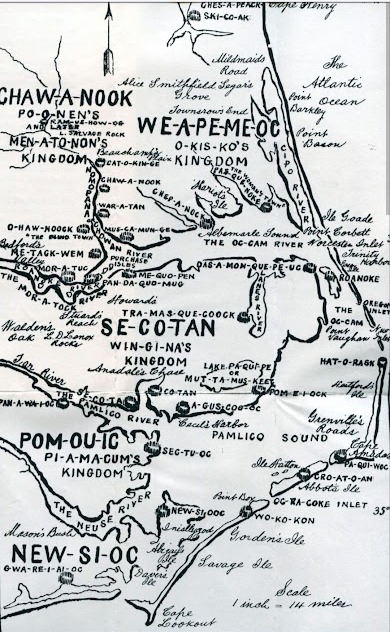
These names would appear repeatedly as England’s involvement in the region deepened.
Secotan would become central to English exploration and conflict.
Croatoan would eventually become the most famous word associated with the disappearance of the 1587 colonists.
Chawanook would draw English attention inland toward the powerful communities and waterways surrounding the Chowan River.
In 1584, however, those later events remained unknown.
To Barlowe, the names represented the geography of a newly encountered world.
To the people who lived there, they represented homelands whose histories extended far beyond England’s arrival.
A Story of Earlier Survivors
Among the accounts Barlowe heard was a story concerning white men who had survived a shipwreck years before the English expedition arrived.
According to what he was told, the survivors had lived among neighboring Native people.
Barlowe could not verify the story.
He did not claim that he had personally seen the men or discovered physical evidence of their presence. He simply preserved the account as it had been related to him.
That distinction is important.
The documentary record contains observations, reports, rumors, misunderstandings, and secondhand testimony. They must not all be treated as equal forms of evidence.
Barlowe’s decision to record the story without pretending to prove it offers an early example of the principle that must guide the Lost Colony investigation:
Evidence and interpretation should remain separate.
What the witness saw must be distinguished from what the witness heard.
What can be established must be distinguished from what remains possible.
Manteo and Wanchese
As the summer drew to a close, Amadas and Barlowe prepared to return to England.
They carried maps, observations, samples, and descriptions of a country they believed could support a future English colony.
They also carried something far more important.
Two Native men agreed to accompany the expedition across the Atlantic.
Their names were Manteo and Wanchese.
In England, they would provide Raleigh and his advisers with knowledge unavailable from any map. They understood the region’s people, waterways, languages, political relationships, and geography.
Yet their experiences in England would affect them differently.
Manteo would later become one of England’s most important Native allies.
Wanchese would return increasingly suspicious of English intentions.
Their opposing reactions foreshadowed the uncertainty that would soon replace the peaceful atmosphere Barlowe described.
The first voyage had established contact.
The voyages that followed would test whether that contact could survive England’s ambitions.
The Report That Changed Raleigh’s Plans
Barlowe returned to England carrying conviction.
The country possessed fertile soil, rich natural resources, extensive waterways, and established communities that had initially welcomed the newcomers with remarkable generosity.
His report transformed Raleigh’s colonial vision into an actionable plan.
Before Barlowe’s return, Virginia existed in England largely as possibility.
Afterward, it became a destination.
Ships could be fitted.
Supplies could be gathered.
Soldiers, craftsmen, scientists, and governors could be recruited.
England had crossed the Atlantic to observe.
It would soon return intending to remain.
That decision would bring Thomas Harriot, John White, Ralph Lane, and hundreds of English sailors and soldiers into the Roanoke story.
It would also place increasing pressure upon the Native communities whose hospitality had made Barlowe’s successful voyage possible.
For the moment, however, there was no abandoned settlement.
There was no carved word.
There was no Lost Colony.
There was only discovery—and England’s growing determination to possess what Arthur Barlowe had described.
Continue the Investigation
Previous installment:
Chapter One — A New World Beckons
Coming next:
Chapter Three — England Plants Its First Footprint
Arthur Barlowe had shown England what Virginia appeared to be.
In 1585, Sir Walter Raleigh would send a much larger expedition to discover whether Englishmen could live there.
The age of observation was ending.
The colonial experiment was about to begin.