Broadway Meets Texas Dust

The stagecoach appeared first as a brown cloud on the eastern road.
By the time it reached the outskirts of Dry Wells, Texas, every loose board on the vehicle rattled, every leather strap complained, and the four horses pulling it wore coats darkened with sweat. The driver leaned forward over the reins as though determination alone might carry the coach the final hundred yards.
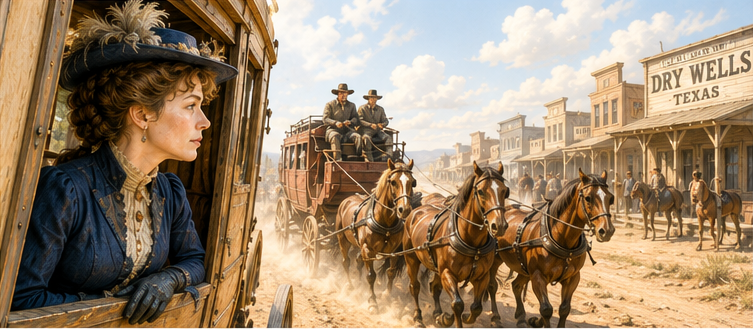
Eleanor Vale watched the town approach through a curtain of dust.
She had left New York nearly three weeks earlier with four trunks, two hatboxes, a traveling secretary, and the firm conviction that civilization ended somewhere west of St. Louis. Her secretary had taken ill in Fort Worth and remained behind. One trunk had disappeared in Arkansas. A hatbox had been crushed beneath a crate of theatrical scenery. The remaining luggage was tied precariously to the roof of the coach.
Eleanor herself remained remarkably intact.
She wore a deep blue traveling dress buttoned to the throat, though the Texas heat had turned it into a personal punishment. Her dark hair had been pinned beneath a fashionable hat that no longer sat at the angle intended by its maker. Dust coated the brim, her gloves, and the tip of her nose.
She was billed throughout the East as Miss Eleanor Vale, the Radiant Star of the American Stage. Broadway audiences had applauded her Juliet, wept for her Camille, and filled the theater for six consecutive weeks to see her portray Lady Macbeth.
At that moment, however, the Radiant Star of the American Stage was considering murder.
“If that driver strikes one more hole in the road,” she announced to no one in particular, “I shall personally see that he is hanged.”
The elderly woman seated opposite her opened one eye.
“They don’t hang people for poor driving in Texas.”
“They should.”
“They mostly hang horse thieves.”
Eleanor glanced toward the coach roof as another trunk shifted ominously.
“By the time we arrive, I may qualify.”
The coach rolled into Dry Wells beneath a sky so large and blue that it made the town appear temporary. A blacksmith shop stood beside a livery stable. Across the road sat a hotel, a saloon, a mercantile store, and a narrow building bearing a hand-painted sign:
DRY WELLS OPERA HOUSE
Eleanor stared at it.
“That,” she said, “is not an opera house.”
The old woman looked out the window.
“It has a door.”
“So does a barn.”
The coach lurched to a stop.
A man stood beside the watering trough, holding the reins of a tall chestnut horse. He wore a weathered hat, a faded blue shirt, and boots that had known more miles than polish. A revolver rested low on his right hip, but he carried himself without the nervous swagger Eleanor had observed among men who wished to be noticed.
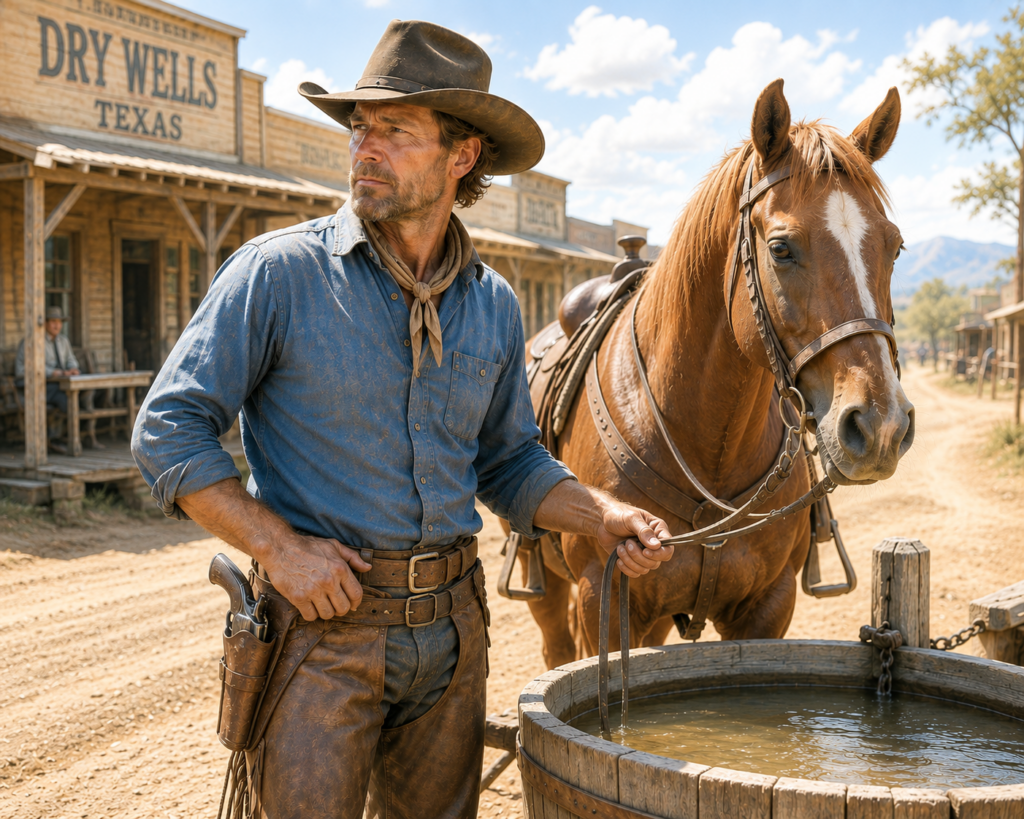
He was neither young nor particularly concerned with appearing so. Silver showed at his temples and in the short beard along his jaw. The sun had marked his face with lines that deepened when he squinted toward the coach.
He watched as the driver climbed down and opened the door.
Eleanor extended one gloved hand.
The driver looked at it.
“What’s that for?”
“You are supposed to assist me.”
“Ma’am, I’ve been assisting that coach for seventy miles.”
The cowboy stepped forward.
Without removing his hat, he offered his arm.
Eleanor studied him for a moment before accepting it.
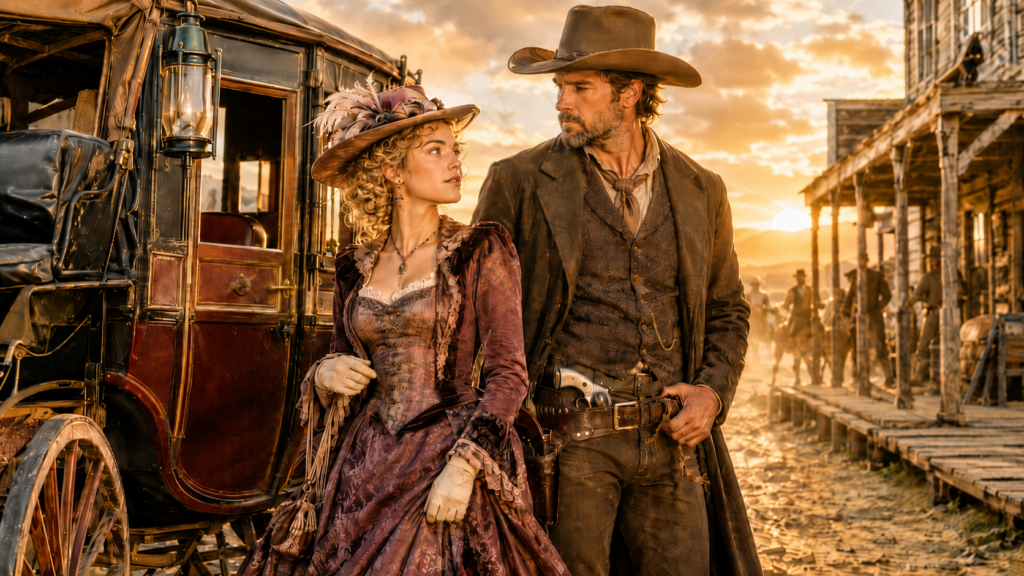
His sleeve was warm beneath her hand. He lifted her down as easily as if she weighed no more than one of her hatboxes.
Her shoes touched the road and immediately sank into two inches of dust.
Eleanor looked down.
The cowboy looked down.
“This town always kept so thoroughly powdered?” she asked.
“Only when it’s dry.”
“And when is it not dry?”
“Last March, for about twenty minutes.”
She turned toward him. His expression remained perfectly serious, although something amused had awakened in his eyes.
“Do all Texas gentlemen introduce themselves by providing weather reports?”
“No, ma’am. Some talk about cattle.”
“And which kind are you?”
“The kind who was holding a horse until a stagecoach got in the way.”
He touched the brim of his hat.
“Daniel Mercer.”
“Eleanor Vale.”
“I know.”
Her eyebrow rose.
He nodded toward a large poster attached crookedly to the opera-house wall. It showed an idealized version of Eleanor reclining against a column beneath the words:
FOR ONE NIGHT ONLY!
THE CELEBRATED NEW YORK STARLET
MISS ELEANOR VALE
Someone had drawn a mustache on her portrait.
Eleanor stared at it in horror.
Daniel glanced at the poster.
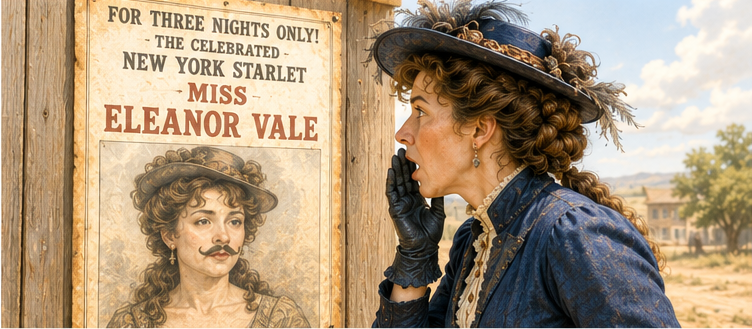
“Mustache favors you.”
She withdrew her hand from his arm.
“Mr. Mercer, I have known you for less than a minute, and already I find you intolerable.”
“Yes, ma’am.”
He did not appear wounded by the judgment.
The coach driver began lowering her remaining trunk. The rope slipped. Daniel moved quickly, catching one end before the trunk struck the ground.
“Careful!” Eleanor cried. “My costumes are in there.”
Daniel steadied the trunk.
“Thought it might be gold.”
“In my profession, Mr. Mercer, they are very nearly the same thing.”
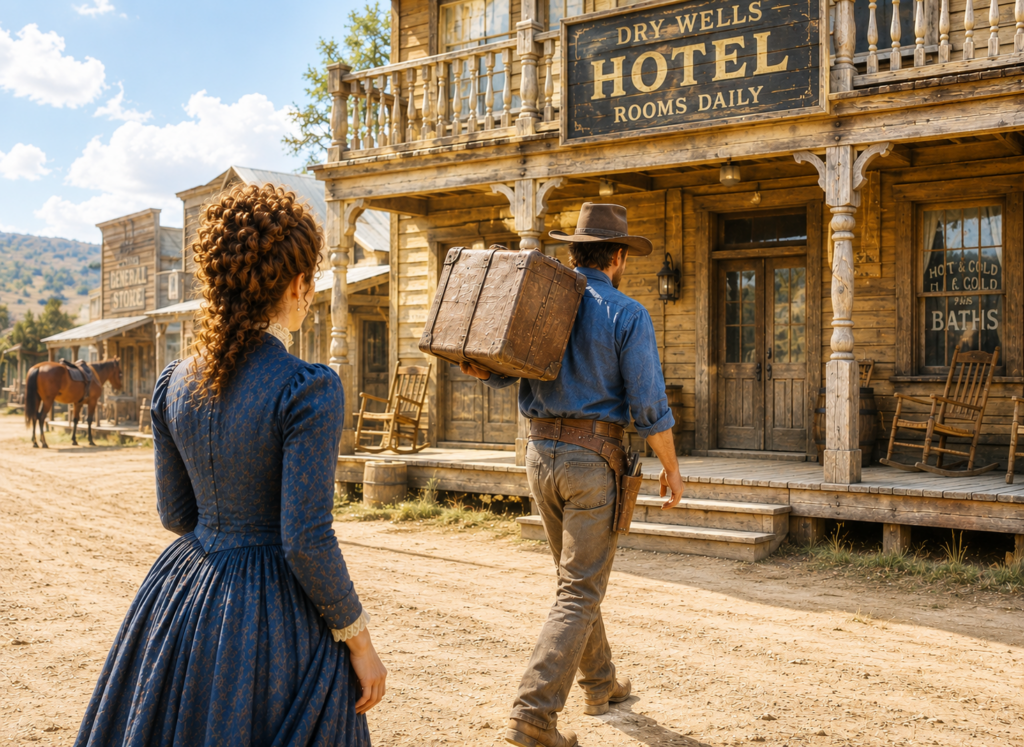
He lifted the trunk onto his shoulder.
“Where do you want it?”
“The hotel.”
Daniel looked across the road at the two-story structure leaning slightly toward the saloon.
“You staying there?”
“That was the arrangement.”
“You may want another arrangement.”
“Is there another hotel?”
“No.”
Eleanor closed her eyes briefly.
When she opened them, Daniel had already started across the road with the trunk.
She followed him.
“Mr. Mercer.”
“Yes, ma’am?”
“I did not ask you to carry that.”
“No, ma’am.”
“I am capable of managing my own affairs.”
“I expect you are.”
“Then why are you helping me?”
He glanced back.
“Because the trunk weighs more than you do.”
That evening, Eleanor stood alone upon the stage of the Dry Wells Opera House.
She had expected crude surroundings, but the building seemed to have been constructed by men who had heard theaters described yet had never entered one. The stage tilted slightly toward the audience. The curtain had once been red but had faded to the color of dried blood. Six rows of mismatched chairs faced the stage, followed by benches for those unwilling or unable to pay for comfort.
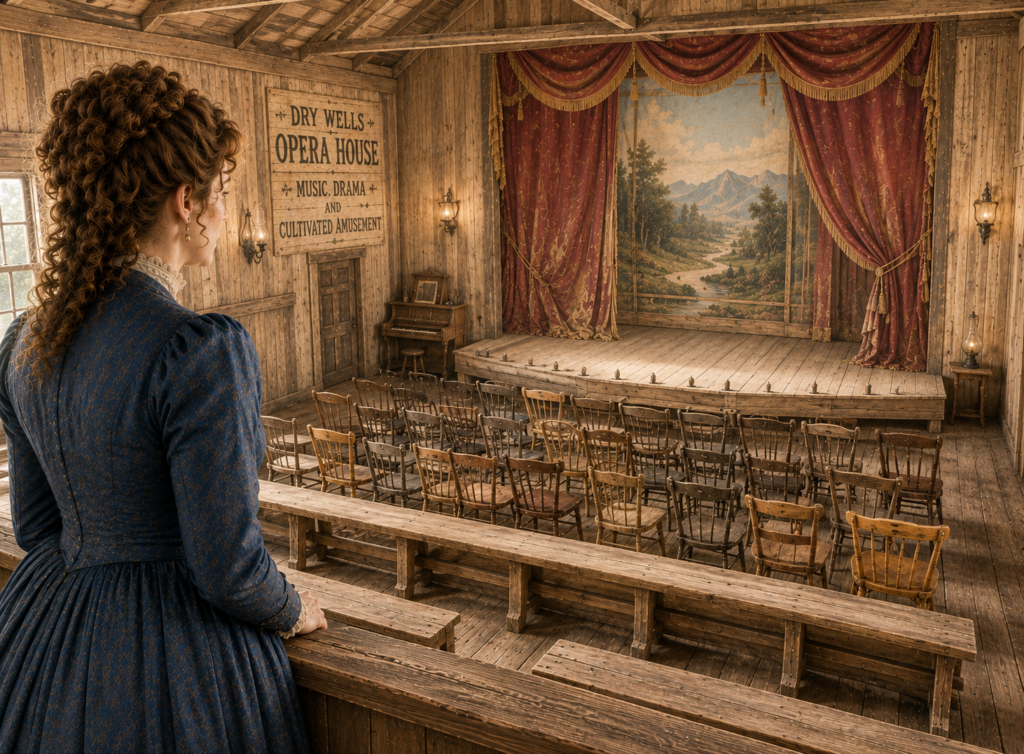
She walked to the center and tested the floor with one foot.
It creaked.
A second step produced a deeper groan.
From somewhere beneath the stage came the scratching of a small animal.
Eleanor looked toward the theater manager.
“What was that?”
Mr. Peabody was a narrow man whose mustache extended farther than his authority.
“Probably mice.”
“It sounded larger than a mouse.”
“Texas mice.”
Eleanor drew a slow breath.
She had traveled west because her New York producer insisted that the tour would restore her drawing power. Theatrical fashion had begun to turn toward younger actresses—women with golden curls, fragile shoulders, and very little objection to being marketed as discoveries.
Eleanor was thirty-nine.
She knew exactly who she was, which had become both her greatest strength and, according to several producers, her principal commercial disadvantage.
Dry Wells was intended as a one-night stop before Dallas. Heavy rains had damaged the northern rail line, and the company’s scenery wagon would not arrive until the following afternoon. Peabody had persuaded her manager to schedule a performance during the delay.
Now she stood in an opera house with no scenery, half a company, and something substantial living beneath the stage.
The rear door opened.
Daniel Mercer entered carrying two lanterns and a wooden toolbox.
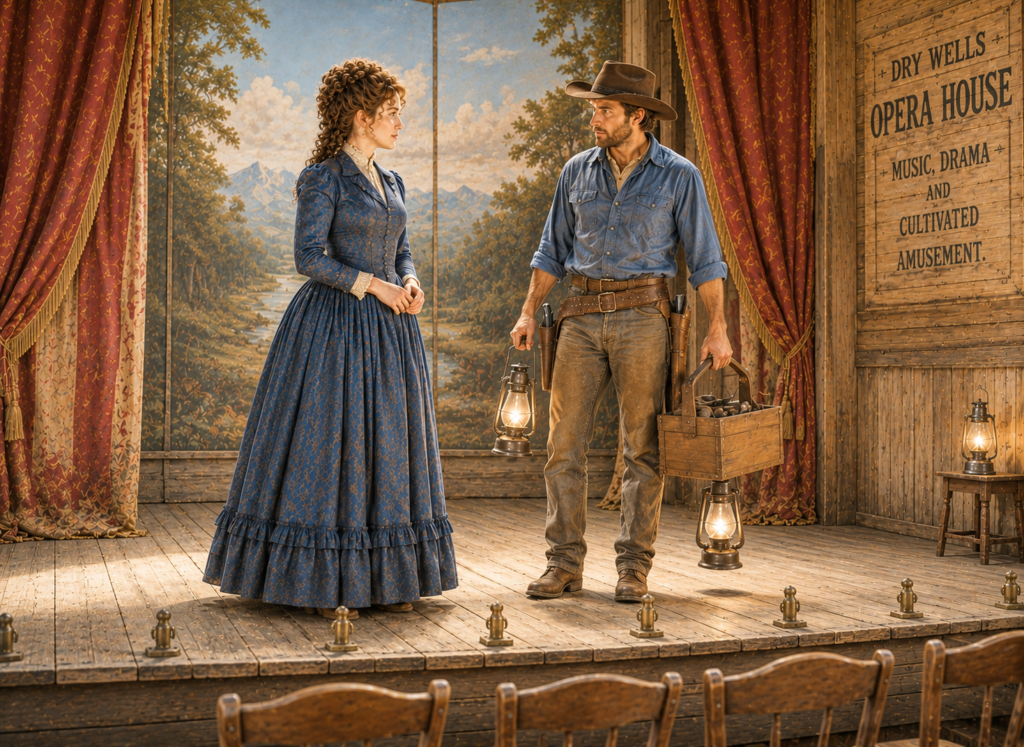
Eleanor folded her arms.
“Has the town appointed you official guardian of visiting actresses?”
“No. Peabody hired me to fix the floor.”
Peabody cleared his throat.
“Mr. Mercer has experience with lumber.”
“He owns a ranch,” Eleanor said.
Daniel looked at her.
“You’ve been asking about me.”
“I asked the hotelkeeper whether you habitually carry strange women’s luggage.”
“And?”
“She said only the attractive ones.”
For the first time, Daniel smiled openly.
It changed his face.
Eleanor found this inconvenient.
He knelt and examined one of the loose boards. His hands were rough and scarred, but his movements were careful. He removed the damaged plank, measured a replacement, and began cutting it with a small hand saw.
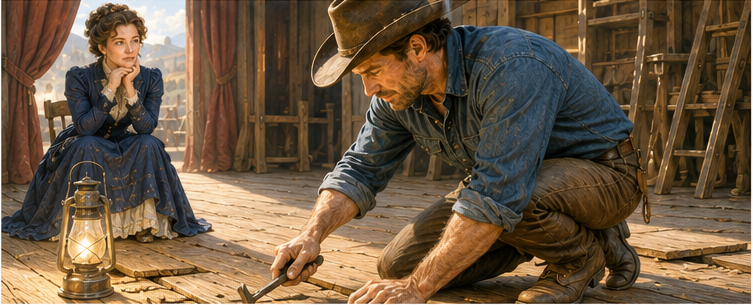
Eleanor sat in the front row and watched.
“Were you born here?” she asked.
“Close enough.”
“Have you ever been to New York?”
“No.”
“Have you ever seen a proper theatrical production?”
“No.”
“Have you ever read Shakespeare?”
Daniel continued sawing.
“Some.”
“Some?”
“My mother had a book.”
Eleanor regarded him with new interest.
“Which play?”
“Several of them.”
“Name one.”
He stopped sawing and looked up.
“Are you testing me, Miss Vale?”
“I am attempting to determine whether you are civilized.”
Daniel considered this.
Then, in a voice quieter and more measured than she expected, he recited:
“‘There is a tide in the affairs of men, which, taken at the flood, leads on to fortune.’”
Eleanor said nothing.
Daniel returned to his work.
“My mother liked that one.”
“Julius Caesar,” Eleanor said.
“So the book claimed.”
“You have been concealing yourself, Mr. Mercer.”
“Wasn’t aware I needed finding.”
She watched him fit the new board into place.
“Everyone needs finding.”
The words escaped before she could judge them. Daniel’s hammer stopped above the nail.
For a moment, neither spoke.
Then he drove the nail home.
The following evening, every chair and bench in the opera house was occupied.
Ranchers arrived with their wives. Shopkeepers closed early. Children were scrubbed, combed, and threatened into silence. Men who would not ordinarily have admitted to an interest in theater stood at the back beneath the balcony.
Daniel Mercer sat in the final row.
Eleanor noticed him before the curtain rose.
She had chosen to perform scenes from three plays, connected by short introductions. There was no scenery beyond a table, a chair, and a painted garden backdrop borrowed from a church pageant. Her supporting actors were exhausted, the lighting was poor, and the orchestra consisted of a pianist and a boy with a violin.
None of it mattered after she spoke her first line.
Her voice filled the room.
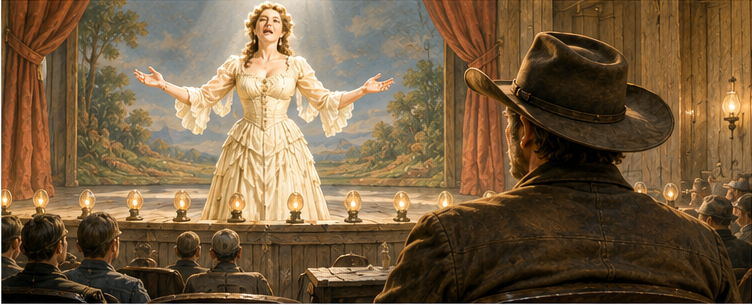
The dusty opera house disappeared. The warped boards became the floor of an English castle. The faded curtain opened onto Paris. For nearly two hours, Eleanor Vale commanded the attention of people who had arrived expecting novelty and found themselves witnessing art.
Daniel did not shift in his seat.
During the final selection, Eleanor portrayed a woman saying farewell to the man she loved. The scene was not famous, nor was it especially fashionable, but Eleanor had chosen it because the words carried a truth that had followed her west.
“You came too late,” her character said. “Not because the hour had passed, but because I had persuaded myself that no one was coming.”
Her gaze found Daniel in the darkness.
He lowered his hat onto his knee.
When the scene ended, the theater remained silent for one suspended breath.
Then the audience rose.
The applause rolled through the little building like thunder.
Afterward, Eleanor returned to the hotel dining room. She found Daniel seated alone at a corner table, a cup of coffee beside his elbow.
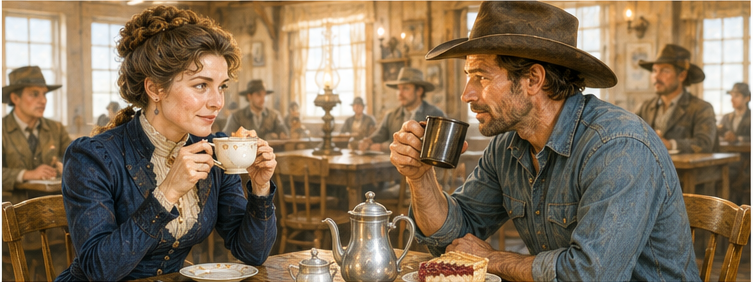
“Mr. Mercer.”
He stood.
“Miss Vale.”
“Well?”
“Well what?”
“You attended the performance.”
“I did.”
“And?”
“You already heard all those people clapping.”
“I did not ask what they thought.”
Daniel pulled out the opposite chair.
Eleanor sat.
He returned to his place.
“You were good,” he said.
“Good?”
“Very good.”
“I have crossed half a continent, endured a homicidal coach driver, lost one trunk, and performed Shakespeare on a stage inhabited by an animal large enough to collect rent—and your verdict is that I was very good?”
Daniel sipped his coffee.
“I don’t use many adjectives.”
“You should consider acquiring more.”
“I’ll put it on the list.”
A serving girl brought Eleanor tea and a slice of pie. Daniel reached for his coffee again, but his sleeve caught the edge of the saucer.
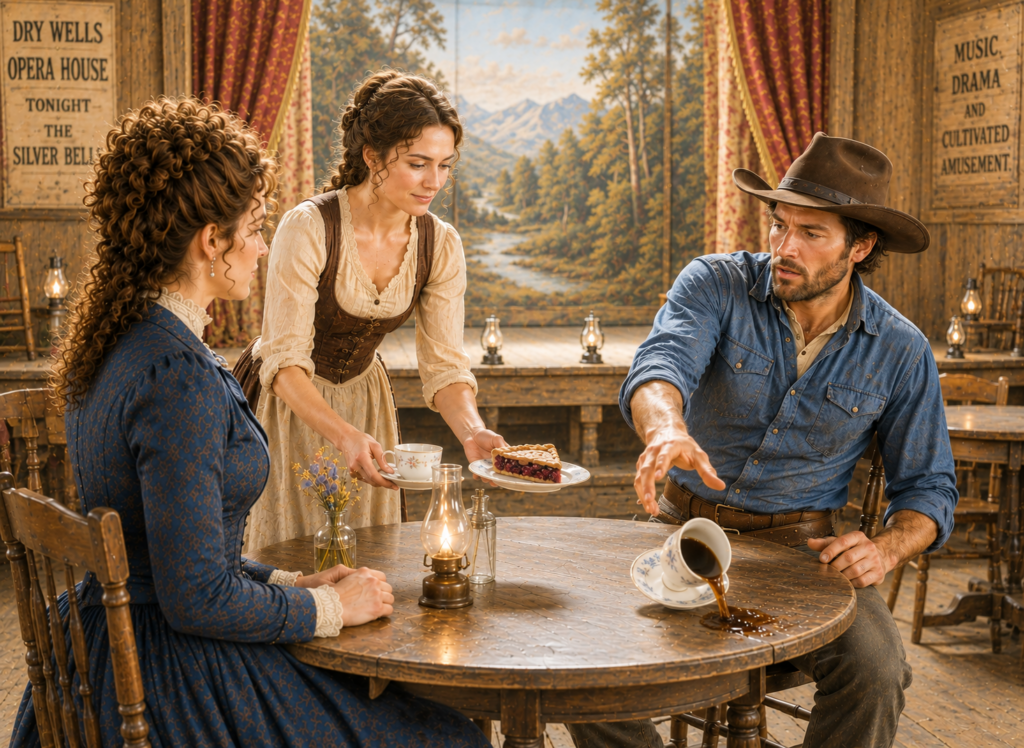
Without thinking, Eleanor moved the cup safely away from his elbow.
Daniel looked at the cup.
Then he looked at her.
She realized what she had done.
“I was preventing a spill.”
“Yes, ma’am.”
“You seemed unaware of the danger.”
“Yes, ma’am.”
“Do not make too much of it.”
“I wouldn’t dare.”
His eyes said otherwise.
Outside, wind moved along the street, lifting dust against the windows. The lamps flickered.
Eleanor removed her gloves.
“I leave for Dallas tomorrow.”
“So I heard.”
“The company will continue to St. Louis, Chicago, and then back to New York.”
“That’s a long way.”
“It is the life I chose.”
Daniel turned the coffee cup slowly between his hands.
“You happy with it?”
Eleanor almost gave the practiced answer. She had used it with reporters, theater owners, and curious strangers for twenty years.
Instead, she said, “Sometimes.”
“That enough?”
“It has always had to be.”
Daniel nodded as though he understood more than she had told him.
She looked toward the darkened window.
“And you? Are you happy on your ranch?”
“Sometimes.”
“Is that enough?”
“Has always had to be.”
She smiled despite herself.
The next morning, the coach stood before the hotel.
Her trunk had been secured to the roof. The surviving hatbox rested inside. Peabody had arrived with flowers. Townspeople gathered to wave goodbye to the celebrated actress from New York.
Daniel was not among them.
Eleanor told herself she had not expected him.
She entered the coach, settled against the seat, and looked straight ahead as the driver climbed into position.
The horses started forward.
At the edge of town, Eleanor heard hoofbeats.
Daniel rode alongside the coach on the chestnut horse. He reached into his coat and passed a small package through the open window.
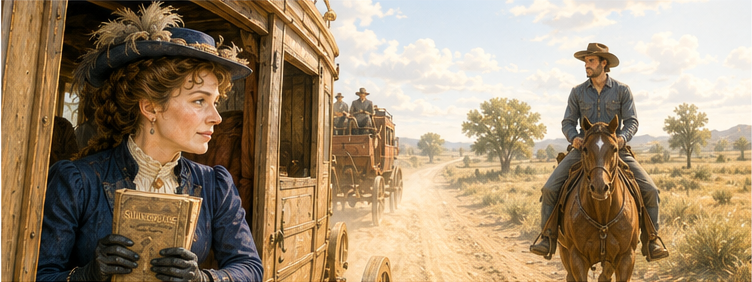
“What is this?” she asked.
“Something for the road.”
She unfolded the brown paper.
Inside was a worn book of Shakespeare.
The leather cover had cracked with age. On the first page, written in a woman’s hand, were the words:
To Daniel—so that no road may take you beyond the reach of good company.
Eleanor looked at him.
“I cannot accept this.”
“Already did.”
“It belonged to your mother.”
“She would’ve liked you.”
Eleanor held the book against her lap.
The coach continued moving.
Daniel slowed his horse.
“Will I see you again?” she asked.
He touched the brim of his hat.
“You said everyone needs finding.”
“That is not an answer.”
“It’s the only one I’ve got.”
The coach carried her eastward toward Dallas.
For a long while, Daniel remained behind them, horse and rider motionless in the road, growing smaller through the dust.
Eleanor opened the book.
Between the pages of The Tempest, she found a folded piece of paper.
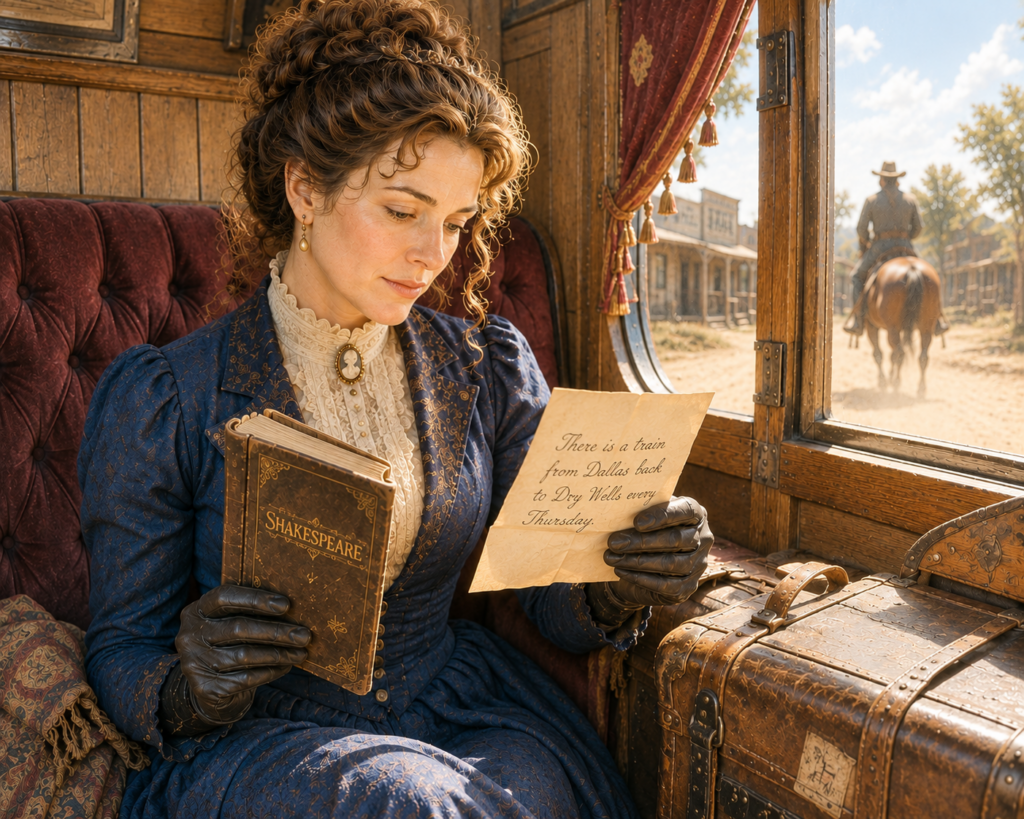
On it Daniel had written only one sentence:
There is a train from Dallas back to Dry Wells every Thursday.
Eleanor read it twice.
Then she leaned toward the window and called to the driver.
“How long shall we remain in Dallas?”
“Four days, ma’am.”
She looked down at the note.
Four days meant they would finish on Wednesday.
Thursday was entirely unoccupied.
Eleanor settled back against the seat, hiding her smile behind the little book.
Outside, Texas stretched endlessly beneath the morning sky, and somewhere behind her waited an intolerable cowboy who did not use enough adjectives.
For the first time in many years, Eleanor Vale found herself looking forward to an unscheduled performance.