The Fuel Paradox
Amelia Earhart’s Final Hours
and the Problem of “Gas Is Running Low”
Author: Douglas Estill
Neapolis Forgotten Paths Research Institute
Abstract
The disappearance of Amelia Earhart and Fred Noonan near Howland Island on 2 July 1937 has long been explained through a deceptively simple sequence: the aircraft failed to locate Howland.
Earhart reported that her fuel was low, the Lockheed Electra exhausted its gasoline, and the aircraft descended into the Pacific somewhere near the island.
The simplicity of that reconstruction has allowed it to become something close to historical shorthand. The surviving contemporary evidence, however, is considerably less certain.
This study re-examines the fuel question using the United States Navy and Coast Guard search report, contemporary USCGC Itasca radio records, surviving information concerning the Electra’s departure fuel load, and the fuel-consumption recommendations prepared by Lockheed engineer Clarence “Kelly” Johnson.
The official search report itself preserved two substantially different endurance calculations for the aircraft: approximately twenty-four hours under economical conditions and approximately twenty and one-half hours at the higher assumed consumption rate of fifty-three gallons per hour.
Earhart’s statement that “gas is running low,” received approximately nineteen hours and twelve minutes after departure from Lae, is therefore less conclusive than is frequently assumed.
The evidence establishes that fuel had become an operational concern. It does not independently establish the quantity remaining, the time at which exhaustion occurred, or the geographical position at which the aircraft would necessarily have descended.
The distinction is important. Before Earhart’s disappearance can be reconstructed geographically, the fuel evidence must first be separated from the assumptions that have accumulated around it.
Keywords: Amelia Earhart; Fred Noonan; Howland Island; Lockheed Electra 10E; USCGC Itasca; aviation navigation; fuel endurance; Pacific aviation; 1937
I. The Sentence That Became the Ending
Few sentences in twentieth-century aviation history have carried more weight than four words transmitted from Amelia Earhart’s Lockheed Electra on the morning of 2 July 1937:
“Gas is running low.”
Those words have become, in many retellings of the Earhart disappearance, almost the final scene of the story.
Earhart and navigator Fred Noonan had flown through the night from Lae, New Guinea, toward a speck of coral in the central Pacific. They could not see Howland Island.
The Coast Guard cutter Itasca could hear Earhart, but effective two-way radio communication had not been established. Then came the report that the aircraft must be near the island, followed by the statement that its fuel was running low.
From there the conventional narrative almost writes itself.
They missed Howland. They were nearly out of fuel. They searched until the tanks were empty. The Electra went down somewhere nearby.
There is nothing inherently unreasonable about that reconstruction. Indeed, it remains one possible explanation for the disappearance.
But possible is not the same thing as demonstrated.
The difficulty is that the surviving records do not tell us how much gasoline remained when Earhart made that statement. They do not tell us precisely what power settings she had used during the preceding nineteen hours.
They do not establish her average fuel consumption. They do not tell us how much additional fuel was consumed while searching for Howland.
And, perhaps most importantly, the contemporary records do not consistently say that Earhart reported she had only thirty minutes of fuel remaining.
What the strongest contemporary record says is simpler:
The gas was running low.
That is an important statement. It is also an imprecise one.
When examined against the endurance figures preserved in the Navy’s own search report, the phrase creates what may properly be called the fuel paradox.
According to one official calculation, Earhart could indeed have been approaching exhaustion. According to another calculation preserved on the very same page, the Electra could still have possessed several hours of endurance.
Both cannot describe the aircraft’s actual fuel state at the same moment.
The problem, therefore, is not to decide which version of the Earhart legend we prefer. It is to determine what the evidence will actually carry.
II. Lae: 1,100 Gallons and a Very Heavy Airplane
The Electra that departed Lae at approximately 0000 Greenwich Civil Time on 2 July was not an ordinary Lockheed 10E.

NR16020 had been extensively modified for long-distance flight. Additional fuel tanks occupied much of the cabin, transforming a small commercial transport into an aircraft capable of exceptionally long over-water legs.
The official United States Navy and Coast Guard report prepared after the disappearance recorded among its “known facts” that the Electra departed Lae with 1,100 U.S. gallons of gasoline.
That figure is crucial.
It is also worth emphasizing what the Navy did not say. The official investigators did not begin with the assumption that 1,100 gallons represented merely enough fuel to reach Howland with a razor-thin margin.
Their own calculations attributed considerably greater theoretical endurance to the aircraft.
The report listed an economical airspeed of approximately 130 knots. At optimum carburetor adjustment, the Navy estimated a still-air range of approximately 3,120 nautical miles and an endurance of approximately twenty-four hours, based upon an average consumption of 45.8 gallons per hour.
Immediately afterward, however, the report supplied another calculation.
At an average consumption of 53 gallons per hour, the same 1,100 gallons provided only approximately 20.5 hours of endurance.
Therein lies the problem.
One airplane.
One stated departure fuel load.
Two materially different endings.
Under one model the Electra could theoretically remain airborne until approximately midnight Greenwich time, roughly four hours beyond its final authenticated transmissions.
Under the other, exhaustion would occur not long after those transmissions ceased.
The difference is not a trivial rounding error. It represents approximately three and one-half hours of flight.
At an economical cruising speed, that is a very large piece of ocean.
III. Fuel Consumption Was Not a Fixed Number
It is tempting, especially when reconstructing historical flights, to assign an aircraft a single fuel-consumption figure and multiply.
Aircraft do not work that way.
Fuel consumption changes with engine speed, manifold pressure, altitude, mixture setting, aircraft weight, climbing, descending and the decisions of the pilot.
That was particularly important in Earhart’s Electra.
Before the world flight, Lockheed engineer Clarence “Kelly” Johnson conducted fuel-consumption work relating specifically to Earhart’s aircraft and transmitted detailed operating recommendations.
His surviving communications show consumption rates changing significantly as the aircraft became lighter and the flight progressed.
Higher fuel consumption was expected during the early stages of a long flight when the airplane was heavily loaded. After several hours, reduced power settings and careful mixture leaning could lower the burn rate substantially.
Johnson’s recommendations therefore contemplated a progressive reduction in consumption rather than twenty hours at a single fixed figure.
That distinction matters greatly when we begin reconstructing the final hours.
If one simply divides 1,100 gallons by twenty and one-half hours, an average rate slightly above fifty-three gallons per hour appears reasonable.
But that figure tells us nothing about when the fuel was burned.
A long-range aircraft might consume fuel much more rapidly during takeoff, climb and the early heavy portion of the flight and substantially less during the later cruise.
Conversely, unfavorable weather, lower-than-planned altitude, richer mixture settings, course changes, or prolonged operation at greater power could increase consumption.
We therefore have to resist a seductive but dangerous equation:
Fuel aboard ÷ average consumption = exact moment of exhaustion.
That produces a mathematical answer.
It does not necessarily produce a historical one.
IV. Nineteen Hours and Twelve Minutes
The most important fuel transmission was received by Itasca at approximately 0742 Howland time, corresponding to approximately 1912 Greenwich Civil Time.
The Electra had then been airborne for roughly nineteen hours and twelve minutes.
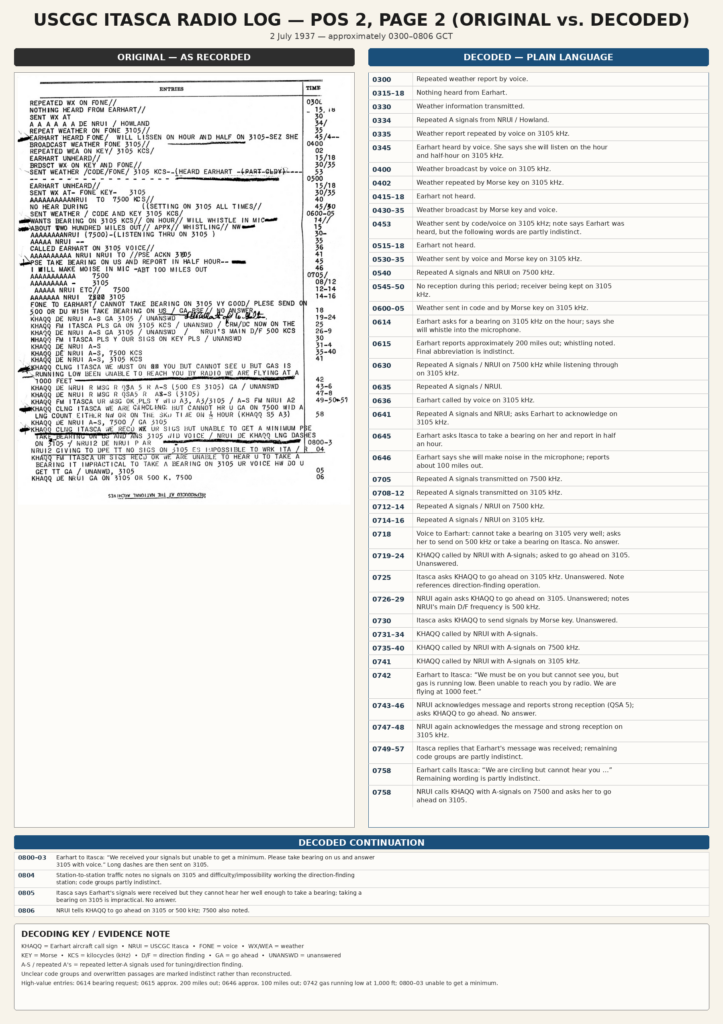
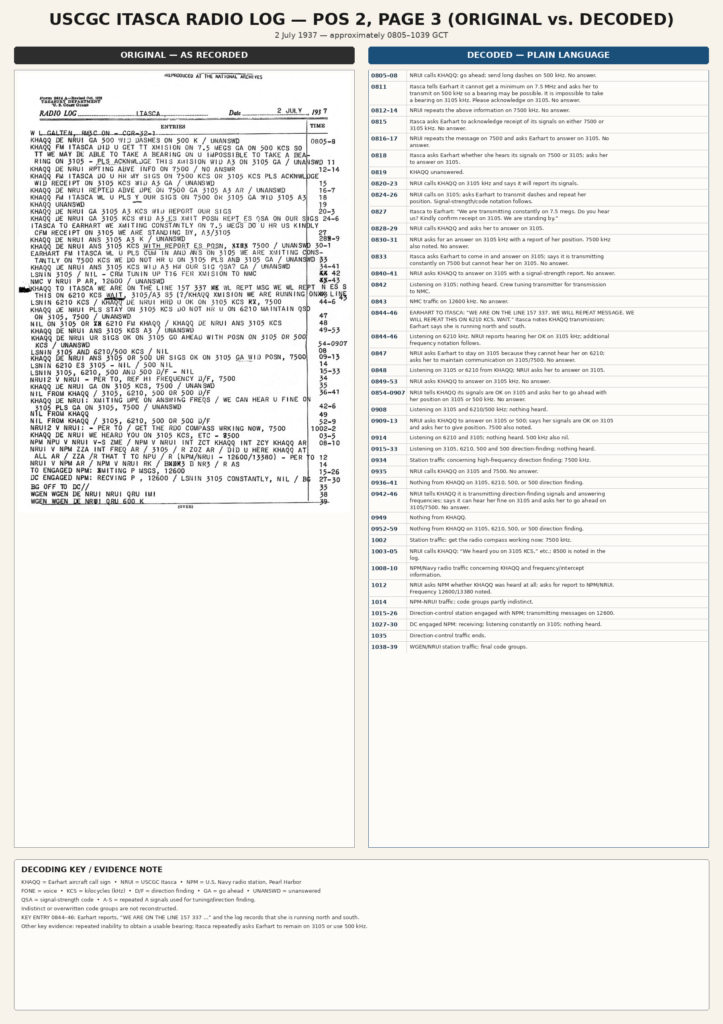
The primary Itasca radio record preserves Earhart reporting that she believed they must be near the ship but could not see it, that they had been unable to establish radio contact, that they were flying at approximately 1,000 feet, and that “gas is running low.”
Let us examine what the Navy’s two endurance assumptions would mean at that moment.
If 1,100 gallons had been consumed at an average rate of 45.8 gallons per hour, approximately 879 gallons would have been burned during the first nineteen hours and twelve minutes.
That would leave approximately 221 gallons.
At the same rate, this represented roughly 4.8 additional hours of endurance.
Now apply the Navy’s less economical figure.
At 53 gallons per hour, approximately 1,018 gallons would have been consumed.
The remaining quantity would have been only about 82 gallons, corresponding to approximately one hour and thirty-three minutes at that same rate.
The difference is enormous.
Under the economical model, Earhart had just entered what could reasonably be regarded as her reserve.
Under the higher-consumption model, the reserve was becoming critically short.
Both scenarios are compatible with the phrase “gas is running low.”
Neither can be selected merely by repeating the phrase.
That is the paradox.
V. The Problem of “Only Half an Hour Left”
An even more dramatic version of the transmission entered the historical record.
A secondary Itasca log contained wording interpreted as Earhart saying that she was running out of gasoline and had only half an hour remaining.
That version has been repeated so often that it has sometimes displaced the primary wording entirely.
The distinction is critical.
The principal Earhart radio log records “gas is running low.” The Itasca bridge record similarly described the aircraft as near the island with its gasoline running low.
The “half hour” wording survives in another log and was associated with what another operator believed he had heard.
That does not mean the entry should simply be thrown away. Contemporary conflicting evidence is still evidence.
But it has to be weighted.
And here chronology presents a serious difficulty.
Approximately sixteen minutes after the low-fuel transmission, Earhart again called Itasca. During that communication she requested a directional signal on 7500 kilocycles, either immediately or at the scheduled half-hour.
If she genuinely believed the aircraft possessed only thirty minutes of fuel at 0742, the request to wait for a scheduled transmission near the coming half-hour becomes peculiar.
More importantly, the aircraft was still transmitting approximately an hour after the alleged “half-hour fuel” statement.
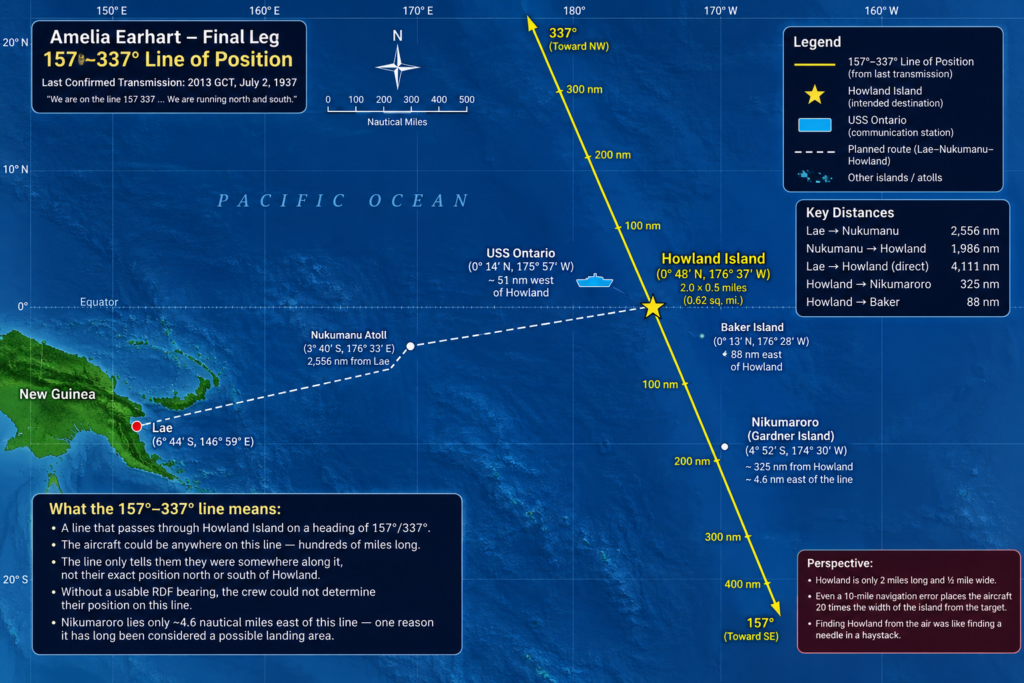
At approximately 0843 Howland time—about 2013 Greenwich—Itasca received the famous position-line message:
“We are on the line 157 337.”
The Electra therefore remained airborne, or at the very least remained capable of transmitting as an airborne station was being heard, about sixty-one minutes after the 0742 call.
That does not prove that the airplane possessed several additional hours of gasoline.
It does prove that a literal interpretation of “only half an hour left” did not accurately predict the aircraft’s endurance from 0742.
The difference between the two statements is therefore more than semantics.
“Only half an hour left” implies an estimated terminal point.
“Gas is running low” describes a condition.
The first can be tested against the clock.
The second cannot.
VI. What Did “Low” Mean to Earhart?
This question is usually approached backward.
Investigators know that Earhart disappeared. They therefore read “gas is running low” as though she were announcing the cause of the disappearance before it occurred.
But that assumes what we are trying to prove.
From Earhart’s position inside the aircraft, the statement may have had a different operational meaning.
She and Noonan had expected to find Howland. They had not.
Their radio arrangement with Itasca was failing.
They could hear some signals but could not obtain a usable direction-finding minimum. Itasca, despite repeatedly hearing Earhart at strong signal strength, had been unable to provide the navigational assistance upon which the flight had partly depended.
At that moment the important quantity was no longer simply the number of gallons in the tanks.
It was time remaining to solve the navigational problem.
A reserve that would have been perfectly acceptable while proceeding toward a known destination could suddenly become uncomfortably small when the destination could not be located.
There is an enormous practical difference between saying:
“I have four hours of fuel.”
and:
“I have four hours of fuel and I do not know where the island is.”
The clock had changed character.
Fuel that had previously represented comfortable reserve now represented the finite period during which Noonan and Earhart could locate land, repair their positional uncertainty, or choose another course of action.
In that circumstance, “gas is running low” could have been both perfectly accurate and entirely rational even if more than an hour—perhaps considerably more—remained.
The phrase should therefore be understood operationally, not theatrically.
Earhart was not necessarily delivering the last line of a tragedy.
She was reporting a rapidly worsening navigational problem.
VII. The Flight Had Already Run Long
There is another component of the fuel problem that is sometimes overlooked.
The Navy search report recorded that Earhart and Noonan had expected to arrive at Howland after approximately eighteen hours.
They did not.
By the time of the 0742 transmission, they had been airborne for more than nineteen hours.
By the final authenticated position-line transmission, they had been airborne approximately twenty hours and thirteen minutes.
Every additional hour mattered.
Using the Navy’s stated Lae-to-Howland distance of approximately 2,227 nautical miles, an eighteen-hour passage would require an average ground speed of roughly 124 knots.
By twenty hours and thirteen minutes, the average based simply upon elapsed time and direct distance falls to approximately 110 knots.
Those numbers should not be mistaken for a precise reconstruction of the actual track. Noonan may have made corrections, and the airplane did not necessarily travel the mathematically shortest line from Lae to Howland.
But the broad implication is unavoidable.
The flight was taking longer than hoped.
A combination of winds, navigation, course corrections and operating conditions had already converted time into additional fuel consumption.
Thus the fuel problem did not suddenly appear at Howland.
It accumulated during the crossing.
The important question is how much reserve that delay had consumed.
And the surviving evidence does not give us a single answer.
VIII. Two Navy Models, Two Possible Electras
The Navy’s own numbers allow us to illustrate the problem through two simplified models.
Model A: Economical Operation
Departure fuel: 1,100 gallons
Average consumption: 45.8 gallons per hour
Theoretical endurance: approximately 24 hours
At 1912 GMT, when Earhart reported that her fuel was running low:
Estimated fuel remaining: approximately 221 gallons
Estimated endurance remaining: approximately 4.8 hours
At approximately 2013 GMT, around the time of the 157–337 transmission:
Estimated fuel remaining: approximately 174 gallons
Estimated endurance remaining: approximately 3.8 hours
Model B: Higher Consumption
Departure fuel: 1,100 gallons
Average consumption: 53 gallons per hour
Theoretical endurance: approximately 20.5 hours
At 1912 GMT:
Estimated fuel remaining: approximately 82 gallons
Estimated endurance remaining: approximately 1.55 hours
At approximately 2013 GMT:
Estimated fuel remaining: approximately 29 gallons
Estimated endurance remaining: approximately thirty-two minutes
The second model produces a striking result.
At the time of the final authenticated transmission, an average consumption of fifty-three gallons per hour places the Electra remarkably close to the famous thirty-minute figure.
But it places that thirty-minute margin approximately an hour later than the disputed 0742 interpretation.
That alone should make us cautious.
The phrase may have migrated in historical memory from an uncertain log entry into a remarkably convenient prediction of what subsequent calculations suggest might have been true later.
Or the aircraft may genuinely have been consuming fuel at approximately the higher rate.
We cannot tell merely from the radio record.
What we can say is that the two official models describe radically different geographical possibilities after 0843.
Thirty minutes of endurance confines the aircraft fairly tightly.
Nearly four hours does not.
IX. The Missing Variable: Actual Fuel Burn
The entire fuel-exhaustion argument ultimately turns on information we do not possess.
There is no surviving fuel-flow record from the Electra.
We do not know precisely how Earhart managed the engines throughout the crossing.
We do not know whether she followed Johnson’s recommended mixture and power schedule exactly.
We do not know how often weather or altitude forced deviations from it.
We do not know how much additional fuel was used in climbs, descents or course changes.
We do not know the exact quantity remaining when the aircraft reached the vicinity of Howland.
That last sentence deserves emphasis because so much of the disappearance literature proceeds as though we do.
We do not.
The historical record supplies a departure quantity and a number of engineering estimates.
The rest must be reconstructed.
Reconstructions are valuable. They are indispensable.
But a reconstruction is not a fuel gauge.
X. Searching Burns Fuel
Once Earhart and Noonan failed to find Howland, their problem became progressively more expensive.
At approximately 1,000 feet, Earhart was apparently attempting to improve visual acquisition of the island.
The aircraft was also trying to solve its radio-direction problem.
At 0758 the radio log recorded a transmission interpreted as stating that they were circling while requesting another signal from Itasca.
Whether every word of that particular entry was received correctly has itself been debated, but the operational reality remains clear: they were no longer merely cruising serenely toward a known point.
They were searching.
Searching consumes time.
Time consumes fuel.
And each minute without a sighting reduces the number of remaining decisions.
By approximately 0843 the problem had become geometrical.
Earhart reported that the aircraft was on the 157°–337° line.
Shortly thereafter the contemporary records associated the aircraft with movement north and south along that line.
That transmission opens a completely different question: what did Noonan’s line of position represent, where did it cross the Pacific, and which direction did they search?
That question belongs to the next installment of this investigation.
For present purposes, one point is sufficient.
At 0843 they were still doing something.
The aircraft had not disappeared at 0742.
It had not exhausted its fuel within the disputed thirty-minute interval.
Whatever happened next occurred after an additional hour of navigation, searching and radio activity.
That hour must be restored to the story.
XI. Fuel Exhaustion Is an Explanation, Not a Position Fix
Perhaps the greatest weakness in traditional discussions of Earhart’s fuel is the tendency to turn a mechanical event into a geographical coordinate.
Suppose, for the sake of argument, that NR16020 eventually exhausted its fuel.
That is entirely plausible.
Unless the aircraft reached land, exhaustion would ultimately become inevitable.
But knowing that an aircraft eventually ran out of gasoline tells us nothing about where it ran out unless we also know its course, speed, remaining endurance and starting position.
Those variables are precisely what remain uncertain.
A thirty-minute fuel reserve after the final transmission and a three-hour reserve after the same transmission produce very different search areas.
So do northbound and southbound travel along the 157°–337° line.
So does circling compared with a deliberate run along a line of position.
So does an immediate ditching compared with continued flight toward another landfall possibility.
Thus “they ran out of fuel” cannot function as the geographical conclusion of the investigation.
At best it describes one likely eventual mechanism by which continued flight became impossible.
The location still has to be demonstrated separately.
XII. The Searchers Themselves Were Not Certain
The actions of the Navy and Coast Guard after the disappearance are also instructive.
If officials had possessed compelling evidence that Earhart had exhausted her fuel immediately adjacent to Howland, one might expect the subsequent search to remain concentrated in that small area.
It did not.
The search expanded dramatically.
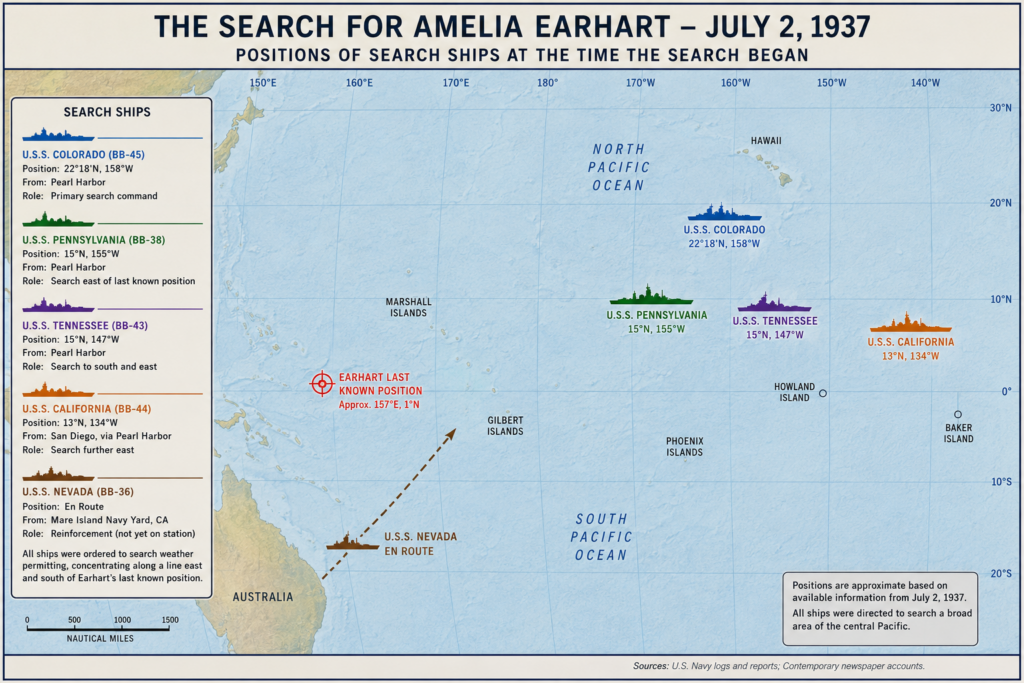
Itasca searched substantial ocean areas. The battleship Colorado and its aircraft later examined portions of the Phoenix Islands. The carrier Lexington and its air group undertook a broad ocean search.
Reported radio transmissions and possible bearings caused investigators repeatedly to reconsider where the Electra might have gone.
The official search report itself catalogued numerous post-loss radio reports while warning that many were contradictory or false.
That history does not prove any particular post-loss transmission genuine.
It does demonstrate something important about the contemporary investigation.
The men actually conducting the search did not possess a sufficiently certain fuel calculation to treat the immediate vicinity of Howland as the only possible location of the aircraft.
They investigated alternatives.
We should be at least as cautious as they were.
XIII. What the Evidence Allows Us to Say
At this stage of the investigation, several conclusions can be stated with reasonable confidence.
First, the Electra was reported to have departed Lae with approximately 1,100 gallons of gasoline.
Second, the official Navy search report preserved substantially different endurance estimates depending upon fuel-consumption assumptions: approximately twenty-four hours at 45.8 gallons per hour and approximately twenty and one-half hours at fifty-three gallons per hour.
Third, Earhart reported at approximately nineteen hours and twelve minutes into the flight that her “gas is running low.”
Fourth, the best contemporary records do not provide an unambiguous statement from Earhart giving an exact quantity of fuel remaining at that moment.
Fifth, the famous assertion that she had only one-half hour of fuel remaining derives from a conflicting log record and is difficult to reconcile literally with subsequent transmissions.
Sixth, the Electra remained in radio contact for approximately another hour.
Seventh, depending upon which contemporary fuel model most closely approximates actual aircraft operation, the Electra may have possessed anything from a relatively short reserve to several hours of theoretical endurance during the final phase of the flight.
And eighth, no surviving record tells us which model accurately represents the aircraft.
Those are not small qualifications.
They change the nature of the problem.
XIV. What the Evidence Does Not Allow Us to Say
The evidence does not allow us to state as established fact that Earhart had only thirty minutes of fuel remaining when she first reported the fuel situation.
It does not allow us to calculate the exact minute at which the tanks became empty.
It does not establish that the aircraft descended immediately after the last authenticated transmission.
It does not establish that fuel exhaustion occurred within sight, radio range or a particular radius of Howland Island.
It does not establish whether Earhart and Noonan continued north, south, alternated direction, circled, or eventually abandoned the Howland search altogether.
Those questions require other evidence.
That evidence exists—in navigation reports, radio logs, search tracks, weather information, post-loss signal reports, contemporary bearings and the movements of the vessels and aircraft dispatched after them.
But those sources must be examined on their own terms.
The phrase “gas is running low” cannot be permitted to answer all of them.
XV. The Fuel Paradox
The Earhart disappearance contains many mysteries, but the fuel question is unusual because the contradiction appears within the contemporary official record itself.
The United States Navy knew that the Electra carried approximately 1,100 gallons.
It also knew that the airplane’s endurance depended heavily upon how efficiently those gallons were used.
The Navy therefore preserved both an economical twenty-four-hour estimate and a higher-consumption twenty-and-one-half-hour estimate.
Later generations have tended to remember only the version that best fits the assumed ending.
If Earhart crashed near Howland soon after her final transmission, the higher-consumption model looks attractive.
If she continued flying, the economical model becomes important.
That is precisely backward.
The proposed fate of the aircraft should not be used to choose the fuel model.
The fuel evidence should be examined independently and then used—carefully—to test the proposed fate.
Otherwise, the argument becomes circular:
Earhart must have crashed near Howland because she was nearly out of fuel.
We know she was nearly out of fuel because she crashed near Howland.
That will not do.
Conclusion: She Was Low on Time as Much as Fuel

By 0742 on the morning of 2 July 1937, Amelia Earhart had good reason to be worried.
Howland Island was not visible.
Radio communication was failing.
The flight had lasted longer than expected.
The Electra had descended to approximately 1,000 feet.
And somewhere behind the instrument panel, 1,100 gallons of gasoline had been reduced to an unknown remainder.
Her statement that the gas was running low should therefore be taken seriously.
But it should be taken literally, not enlarged.
She said the fuel was running low.
The strongest surviving evidence does not tell us how low.
That difference may amount to several hours of flight.
And several hours in a Lockheed Electra is not a footnote. It is hundreds of miles of Pacific Ocean.
The disappearance of Earhart and Noonan cannot be solved by assuming away that uncertainty.
Before we decide where the Electra went, we must first determine what its crew was trying to do.
At approximately 0843, the last clear clue was not about gasoline at all.
It was about navigation.
Earhart reported that they were on a line:
157–337.
That line is where the next investigation begins.
Sources and Selected Bibliography
Primary Sources
Department of Commerce, Bureau of Air Commerce. Correspondence and reports concerning Amelia Earhart’s 1937 world flight, including reports from Lae, New Guinea. United States government records.
Johnson, Clarence L. “Kelly.” Telegrams and technical communications concerning fuel consumption, engine settings and long-range operation of Amelia Earhart’s Lockheed Electra, March 1937. Lockheed Aircraft Corporation.
USCGC Itasca. Deck Log, 2 July 1937.
USCGC Itasca. Primary Radio Log and associated radio records, 2 July 1937.
United States Navy and United States Coast Guard. Report of the Search for Amelia Earhart, 2–18 July 1937. Records of the Office of the Chief of Naval Operations, Record Group 38, National Archives and Records Administration, National Archives Identifier 305240.
United States Coast Guard. Contemporary reports and correspondence concerning the disappearance and search for Amelia Earhart and Fred Noonan, July 1937.
Secondary and Documentary Studies
Gillespie, Ric. Finding Amelia: The True Story of the Earhart Disappearance. Annapolis: Naval Institute Press, 2006.
International Group for Historic Aircraft Recovery. Documentary transcriptions and analyses of the Itasca radio logs, Kelly Johnson fuel-consumption communications and contemporary Earhart search records.
National Archives and Records Administration. “Records Relating to Amelia Earhart.” Collections relating to the 1937 flight, disappearance and United States Navy and Coast Guard search.
Author’s Note
This article is the first installment in the Neapolis Forgotten Paths Research Institute Earhart Investigation Series.
The purpose of the series is not to defend a predetermined theory of Amelia Earhart’s disappearance, but to reconstruct the surviving evidence in chronological order and distinguish what the contemporary record actually establishes from conclusions subsequently attached to it.
Part II: The 157–337 Line: Reconstructing Earhart’s Final Search for Howland Island will examine the final authenticated transmissions, Fred Noonan’s line of position, the meaning of “running north and south,” and the geographical limits of what the 157°–337° message can actually tell us.