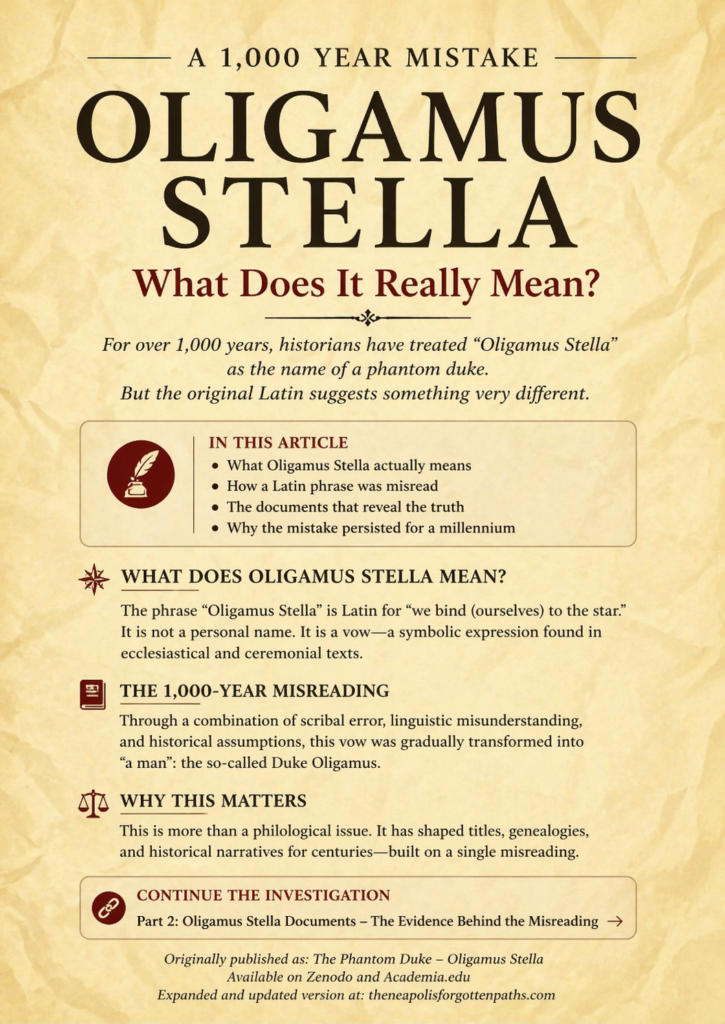
Over time, this phrase was incorrectly split and interpreted as a personal name—creating the illusion of a figure known as “Oligamus Stella,” sometimes later described as a duke (dux), despite no historical evidence. Continue with your journey with the Oligamus Stella the Phantom Duke.
Over time, this phrase, Oligamus Stella – The Phantom Duke was incorrectly split and interpreted as a personal name—creating the illusion of a figure known as “Oligamus Stella,” sometimes later described as a duke (dux), despite no historical evidence. Continue with your journey with the Oligamus Stella the Phantom Duke.
For the full academic paper, including citations, manuscript references, and linguistic analysis visit on Zenodo.org
Author: Douglas Estill
The Neapolis Forgotten Paths Project (2026)
Oligamus Stella –The Phantom Duke: Born from a Misreading
Introduction:
The phrase “Oligamus Stella” meaning has puzzled historians for centuries, often misinterpreted as the name of a medieval duke. In reality, it is most likely a misreading of the Latin nos obligamus, a phrase that was incorrectly divided and transformed into a fictional historical figure.
This article has been in the making for several years. The first time I saw the name “Oligamus Stella,” it was linked in a book that was written by J.H. Estill in a 1903 publication entitled, “The Forgotten Books”. It was an interesting read on the Stella/Estelle/Estill lineage. Sometime after that, I read a publication from 1943 written by Alma Lackey. Her writing was was also entitled “The Forgotten Books”, which was basically an extension of J.H. Estill’s work. Albeit, she was able to include a better and more extensive description of the Estill’s and their historical roles they played in America.
They were able to provide limited information for the d’Estelle/Estelle individuals in Europe during the 15th and 16th centuries, and a historical blip listing an Oligamus Stella/Estelle.
That name of Oligamus Stella, started a period of research. When I would do an internet search the recurring phrase across numerous manuscripts from Naples would simply record: “Nos Oligamus Stella, dux”.
I’ll admit, I got really excited! I thought, I’m related to an honest to goodness Duke of Naples. So, begins the research for Duke Oligamus Stella. Thankfully, I am able to read and translate Latin manuscripts. I read thousands of pages in various books written by exemplary historians.
This story starts with the Italian historian and humanist, Giulio Pomponio Leto. His life was from 1428 – 1498 ad. He was a prolific teacher and scholar. He wrote, “De antiquitatibus urbis Romae libellus” and “De magistratibus”.
From Leto we now turn to another humanist that he was associated with, “Pietro Summonte”. Summonte lived from (1436 – 1526 ad). Summonte was renowned for his roles in preserving and disseminating the works of fellow scholars and humanists of that era.
The third culprit in the Oligamo Stella saga, is Francesco Elio Marchese. Marchese was born in the first half of the 15th century. In Naples, Italy it has been noted that he frequented various cultural circles, coming in contact with various personalities such as Pomponio Leto.
So now, we have all the players listed that contributed to the “Nos Oligamus Stella, dux story”. Let’s add to the mix the books and manuscripts that contributed to the saga: 1.) Raccolta di tutti i piu rinomati scrittori dell’ regno di Napoli 2.) Memorie Cronologighe De’ Vescove 3.) La Nobilita di Napoli 4.) Origene De’ Cognomi Gentilizg Nel Regno Di Napoli.
By now, I am really excited. I have numerous highly esteemed historians and a multitiude of publications mentioning, “Nos Oligamus Stella, dux”. I thought that I had hit pay dirt and found a regal link to the Estill family. Yeah, don’t get too far ahead in the story. Here is how the narrative of “Nos Oligamus Stella, dux took shape.
The premise here is Marchese is supporting a claim that had previously been reported by Pietro Summonte that Pomponio Leto had shown him a fragment of parchment that had been written in Longobarde script mentioning Oligamus and the consuls in 1009 ad.
Now follows the curious parts. Almost verbatim across every book and manuscript that I read about Oligamus and the consuls was recorded the same, even though the authors of many of these books did not live in the same centuries.
So, at that point, I cast a wide net trying to find Oligamus Stella listed independent of the consuls. I searched Byzantine records, the abbeys of Benevento and surrounding areas. The time that I had invested at that point in this research was about year and a half. I could not break the glass ceiling regarding Oligamus.
I had read other historians of the 15th and 16 th century that were doubting that Oligamus was an actual Duke of Naples. And in some respect they were right. If you examine the Dukes of Naples you will not find him listed. Well, it was at this point that life got in the way of my research and the project got shelved for several years.
Two and half years past until I picked up these dusty papers and started re-reading my notes. My mind went back to the time of the research. What went wrong, where did Oligamus go, why can’t I find him listed anywhere else other than that with the consuls. It didn’t make sense if he was a real Duke his name would be plastered all over manuscripts of that era.
Oligamus Stella, dux: It had all the right ingredients, it sounded early, it sounded rare, and it carried just enough mystery to feel important. If you’re doing genealogical or historical work, that’s the kind of name you want to find. When you find a legitimate historical figure, they tend to leave a trail. They show up in multiple records. Their name appears in slightly different forms. They connect to other known people. “Oligamus Stella” did none of that. It just… sat there; no supporting appearances; no variation; no context that made him feel real.
That’s when I stopped asking and started investigating. But the longer I stared at “Nos Oligamus Stella, dux”, the more something felt… off. Grammatically the phrase just didn’t behave like a real person. Syntax wise the Latin wasn’t written cohesively. It was jumbled and the verb and modifiers were all in the wrong place.
———————————————————————————————————–
The Moment Things Started to Unravel:
“What is this line actually saying?” Medieval Latin isn’t like what we’re used to reading. There’s: no punctuation, very little spacing and a heavy use of abbreviations. In other words, you’re not just reading—you’re interpreting structure. And structure can trick you. At one point, I went back and looked at the line again—not as a name, but as a sentence. That’s when something jumped out. – The “word” that changes everything.
I remember one afternoon scouring over pages of manuscripts. It was one of those time consuming and laborious tasks. Typically manuscripts written in Latin do not capitalize proper names. So you read and translate each word in a sentence very slowly so that you don’t skip over something important. That’s when I had my Eureka moment. There it was, buried mid-sentence in the middle of a page. The word was “obligamus”, a very common legal phrase in medieval documents: The phase, “nos obligamus”, means “we bind ourselves” or “we obligate ourselves.” You see it all over charters. It’s boilerplate language.
Now here’s where things get interesting. If you take into account the writing styles during the 15th and 16th centuries, if you remove spacing—or shift it slightly—you get: obligamus → oligamus. And suddenly, a verb becomes a name. When a sentence turns into a person.
Once I saw that, I couldn’t unsee it. What looked like: “Oligamus Stella”, started to look more like: “nos obligamus … [something involving] stella”. In other words: “oligamus” wasn’t a person, it was part of a legal action. And “Stella”? It was likely: a place, a descriptor, or part of a separate clause, …but it had been pulled into the wrong spot.
In another part of the Oligamus Trilogy, we’ll show how Stella actually comes into play. How the Phantom Founder Is Created:
Here’s the part that really matters. Once a phrase gets misread as a name, it takes on a life of its own. Especially if: it looks old, it looks rare, and it fills a gap people want to fill. From there, it’s a short leap to: “This must be an ancestor.” And once that idea gets written down—even once—it starts to stick. Not because it’s correct, but because it’s convenient.
Remember earlier that I mentioned Elio Marchese. Not only was he a prolific author and historian, but he was also the family writer for the Capece lineage. Based on the timeline of 1009 attributed to Oligamo and the consuls, the Capece family was still living in Sorrento. The Capece family is an ancient Italian noble house originating from Sorrento around 1040, renowned for its extensive feudal holdings, military service to medieval monarchs, and enduring patrician status in Naples and southern Italy.[1]
Emerging under the Norman and Swabian dynasties, the family—originally known as Cacapece—relocated to Naples during the reign of King Manfred of Sicily (1258–1266), where members like Marino Capece, brother of the Viceroy of Sicily Corrado Capece, played key roles in royal administration and defense.[1]
Their loyalty to the Swabian cause led to persecution and exile by the Angevin conquerors following the 1268 Battle of Tagliacozzo, with many fleeing to Dalmatia, Sicily, and back to Sorrento; reconciliation with the Angevins in the late 13th century allowed their return, restoration of wealth, and accumulation of baronies.[1]
During that period of time, it was very important for families who wanted to elevate to an aristocratic level to align themselves with an ancient noble. The Capece family was no different, they wanted to be one of the seven seats of Capua in Naples. And if you read the manuscripts, the Capece family align themselves with Oligamus and the consuls, who pre-date their arrival by several hundred years.
As a family historian for the Capece family, Marchese did an effective job of inserting the Oligamus saga into their narrative. From that point on, later humanist writers considered what Marchese wrote about the Oligamus story as being authentic. Why would any author during the middle ages doubt the writings of a Leto, Summonte, Marchese, or a Borelli. And the story took on a life of it’s own and became accepted as truth.
But, when you go back to the manuscripts themselves, the problem becomes obvious. They’re dense. they’re continuous, and they don’t give you clean boundaries between words. In an 11th century Beneventan or early Caroline miniscule manuscript, this is how the Nos Oligamus Stella, dux would have looked like: “nosoligamusstelladux”. When you look at text like this, you realize something important. The reader is doing as much work as the writer. And if the reader expects to see a name…they often will.
So What Happened? At some point, someone: read a compressed Latin phrase; mis-segmented a word (obligamus → oligamus); and attached “Stella” to it. Then treated the result as a person. From there, the name: gets copied, gets repeated, and eventually starts to look legitimate.
———————————————————————————————————–
Why This Matters:
This isn’t just about one name. If “Oligamus Stella” isn’t a real person, then: we may be chasing the wrong origin. We may be building stories on top of a misreading and we may be overlooking the actual people in the record. And that’s the part that really bothered me. Because if this isn’t a person…then something else is hiding in plain sight. At first glance, the question “Where is Stella?” appears to be a straightforward matter of geography. But this assumption depends entirely on whether Stella was ever a place to begin with.
Once I let go of “Oligamus Stella” as a real individual, everything shifted. The question stopped being: “Who is he?” …and became: “What system, place, or people were being described here instead?” That’s where things started to get interesting.
Frequently Asked Questions
What does Oligamus Stella mean?
“Oligamus Stella” is not a real person, but likely a misreading of the Latin phrase nos obligamus, meaning “we bind ourselves.”
Was Oligamus Stella a real duke?
No historical evidence supports the existence of a duke named Oligamus Stella.
Where did the name come from?
It likely originated from a scribal misinterpretation in medieval Latin texts.
Related Research:
Oligamus Stella: The Phantom Founder Behind a Medieval Scribal Error:
Oligamus Stella: Where Is Stella? Tracing the Real Place Behind the Medieval Misreading:
Miles Christi: Before the Templars and the Rise of the First Soldiers of Christ: