Author: Douglas Estill
The Neapolis Forgotten Paths Project (2026)
The Mystery Began With A Duke.
Or so it seemed.
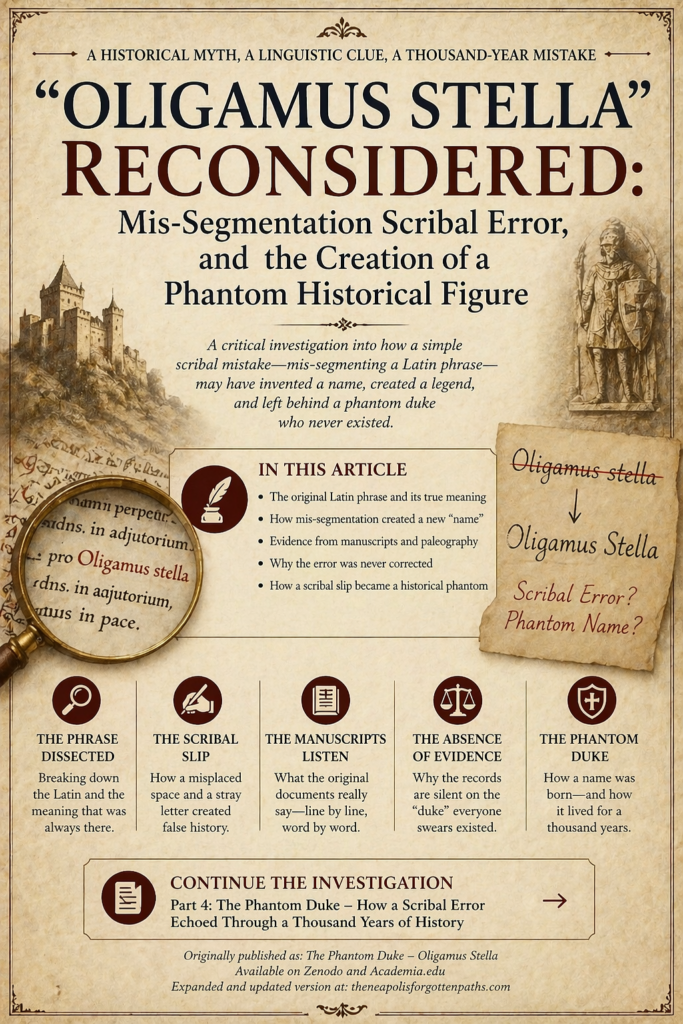
For centuries, historians accepted the existence of a figure known as Oligamus Stella. His name appeared in historical works, genealogical studies, and discussions of medieval Naples. Generations of scholars repeated the name without question, assuming that somewhere in the distant past there had lived a nobleman whose memory survived only in scattered records.
Yet as our investigation unfolded, the story began to unravel.
First, we discovered that Oligamus Stella may never have existed at all. What appeared to be a personal name was likely the result of a medieval scribal misunderstanding.
Then we followed the trail of Stella itself and found evidence suggesting that historians had been searching for a man when they should have been searching for a place.
The phantom duke had vanished.
The landscape remained.
Only one question remained unanswered.
How did the mistake survive for nearly a thousand years?
The answer begins with a simple reality of historical research.
Most historians inherit their evidence.
Very few researchers have the opportunity to examine every original manuscript, charter, and document associated with a particular subject. Instead, scholars frequently depend upon earlier editions, transcriptions, translations, and interpretations produced by those who came before them.
This is not a flaw.
It is the practical necessity of studying the past.
History is built upon layers of scholarship, each generation standing upon the work of previous generations.
Most of the time, this process works remarkably well.
Occasionally, however, an error enters the chain.
And once it does, it can become surprisingly difficult to remove.
Imagine a medieval manuscript copied by hand.
A scribe misreads a phrase.
The copy is preserved.
Years later, another scholar consults that copy and accepts the reading as correct.
A historian cites the scholar.
A later author cites the historian.
A genealogist incorporates the name into a family narrative.
An encyclopedia repeats the information.
A local history adopts the story.
Before long, the error acquires a life of its own.
The original mistake remains hidden beneath layers of repetition.
Each individual author acts reasonably.
Each trusts the work available to them.
Yet collectively, the mistake grows stronger with every retelling.
This appears to be precisely what happened with Oligamus Stella.
At some point in the transmission of medieval texts, an ordinary legal formula was interpreted as a personal name.
The reading entered the historical record.
Subsequent writers encountered the name and assumed that someone before them had already verified its authenticity.
Few had reason to question it.
After all, the figure already appeared in respected works.
The very existence of previous citations became evidence of legitimacy.
And so the phantom duke continued his march through history.
Not because new evidence supported him.
But because old assumptions protected him.
The phenomenon is hardly unique.
History contains countless examples of errors that survived for centuries.
Maps once displayed islands that never existed.
Chronicles preserved legends as facts.
Misread inscriptions created fictional individuals.
Mistaken dates altered historical timelines.
Most eventually disappeared when researchers returned to the original evidence.
Yet until that happened, many were treated as established truth.
Oligamus Stella belongs to this tradition.
His story reminds us that historical certainty is often more fragile than it appears.
There is an important lesson hidden within the mystery.
Historical research is not simply the collection of facts.
It is the continual testing of assumptions.
Every document must be examined.
Every interpretation must remain open to challenge.
Even the most familiar conclusions deserve occasional reconsideration.
The goal is not to prove previous scholars wrong.
The goal is to move closer to understanding what the evidence actually says.
In that sense, the investigation of Oligamus Stella is not a story about failure.
It is a story about how scholarship corrects itself.
As the Pathfinder followed the trail backward through the centuries, the mystery gradually changed shape.
What began as a search for a forgotten duke became an investigation into the transmission of historical knowledge itself.
The real discovery was not the absence of Oligamus.
It was the mechanism that allowed him to survive.
A small misunderstanding.
A copied assumption.
A chain of trust extending across generations.
Together, they created a figure who existed not in medieval reality but in historical memory.
And so the investigation reaches its conclusion.
The phantom duke has been unmasked.
The trail of Stella has been followed.
The error has been traced to its source.
Yet perhaps the greatest lesson lies beyond the specifics of this case.
History is not static.
It is a conversation between the past and the present.
Each generation revisits old questions, examines old evidence, and occasionally discovers that what everyone thought they knew was not quite true.
For nearly a thousand years, Oligamus Stella occupied a place in history.
Not because he existed.
But because a simple error was allowed to travel through time.
His story reminds us that the search for truth is never finished.
And that sometimes the most revealing discoveries are not found in forgotten castles or hidden archives.
Sometimes they are found in a single misunderstood word.
Continue your reading journey with:
The “Pathfinder” Series or The “Miles Christi” Series
Return To Homepage
Related Articles:
Miles Christi: Before the Templars and the Rise of the First Soldiers of Christ
Miles Christi: The Rise of the Soldiers of Christ (900-1100)
Miles Christi Before the Templars: The Emergence of a Christian Military Identity