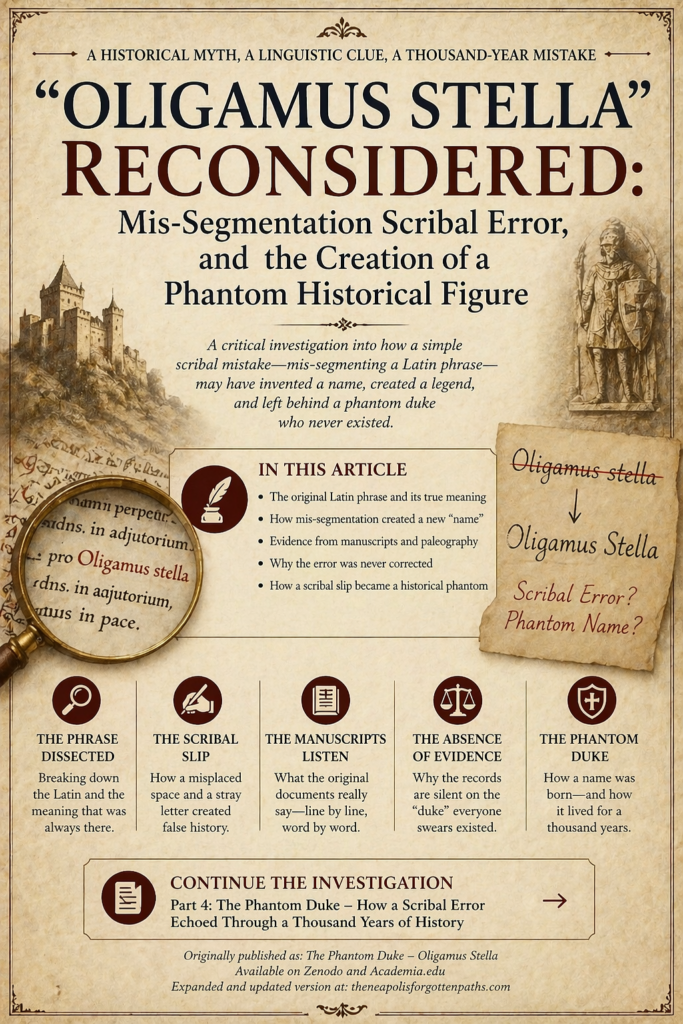
Over time this phrase, Oligamus Stella-The Phantom Duke was incorrectly split and interpreted as a personal name—creating the illusion of a figure known as “Oligamus Stella,” sometimes later described as a duke (dux), despite no historical evidence. Continue with your journey with the Oligamus Stella the Phantom Duke.
For the full academic paper, please visit on Zenodo.org
Author: Douglas Estill
The Neapolis Forgotten Paths Project (2026)
The phrase “Oligamus Stella – The Phsntom Duke” and it’s meaning has puzzled historians for centuries, often misinterpreted as the name of a medieval duke. In reality, it is most likely a misreading of the Latin nos obligamus, a phrase that was incorrectly divided and transformed into a fictional historical figure.
The Name That Never Was
Oligamus Stella has long been interpreted as a historical figure, yet closer analysis suggests the phrase may instead result from a mis-segmentation in medieval Latin, transforming a textual formula into the name of a person who never existed. By examining the language, manuscript transmission, and scribal practices behind the phrase, this study reconsiders Oligamus Stella as a phantom figure created not by history, but by error.
Section I — The Problem No One Questioned
The phrase appears in later historical traditions as if it refers to a person: Oligamus Stella, dux
From this, an identity was constructed:
- A duke
- A leader of consuls
- A founder figure tied to noble lineages
But There Is A Problem
There is no contemporary record clearly identifying such a person.
Instead, what we find are:
- Fragmented Latin phrases
- Copied manuscripts
- Later reinterpretations
Section II — The Mechanics of the Error
The key to the entire mystery lies in how medieval Latin was written.
In many manuscripts:
- Words were written without spacing
- Punctuation was minimal or nonexistent
- Meaning depended on reader interpretation
A phrase like: “nos obligamus stella dux genellus capicius” could easily be misread as:
Oligamus Stella, dux Genellus Capicius
This is segmentation error, and not a translation error.
Section III — Reconstructing the Original Meaning
Let’s break the phrase correctly:
- nos obligamus → “we bind ourselves” / “we are obligated”
- stella → possibly a place, family marker, or symbolic identifier
- dux → leader (not necessarily a formal duke)
- genellus capicius → likely names within a list (Genellus / Capicius)
Instead of a single person, we now have:
A collective declaration, likely from a group such as consuls.
Section IV — Where the Illusion Took Shape
The transformation from phrase → person likely occurred centuries later.
Key figures in this shift include:
- Pomponio Leto
- Giovanni Antonio Summonte
- Francesco Elio Marchese
These writers worked in a period where:
- Manuscripts were already degraded
- Context was partially lost
- There was strong incentive to construct noble origins
A fragmented phrase became a named individual.
Section V — The Capece Connection
The inclusion of names like Capicius (Capece) created a powerful effect:
- It linked the phrase to recognized noble families
- It encouraged historians to interpret the text as genealogical evidence
This is how: A grammatical structure became a bloodline claim
Section VI — Why No One Caught It
This error persisted because it fit expectations:
- Medieval historians expected leaders and founders
- Genealogists sought legitimizing ancestors
- Later readers trusted earlier interpretations
So the illusion reinforced itself.
Section VII — What Oligamus Really Was
When we strip away the misreading, what remains is far more interesting:
- A formal Latin obligation clause
- Likely tied to civic or diplomatic action
- Possibly connected to famine relief negotiations
- Backed by high authority (not independent consuls)
Oligamus: Not a duke. Not a founder. But a voice of obligation.
Conclusion — The Birth of a Phantom
“Oligamus Stella, dux” was never a man.
It was:
- A phrase
- A function
- A misunderstanding
And from that misunderstanding, a phantom was born—one that would persist for centuries.
Frequently Asked Questions
What does Oligamus Stella mean?
“Oligamus Stella” is not a real person, but likely a misreading of the Latin phrase nos obligamus, meaning “we bind ourselves.”
Was Oligamus Stella a real duke?
No historical evidence supports the existence of a duke named Oligamus Stella.
Where did the name come from?
It likely originated from a scribal misinterpretation in medieval Latin texts.
Related Articles
Oligamus Stella Meaning: What Does “Oligamus Stella” Mean?
Miles Christi Before the Templars: The Emergence of a Christian Military Identity: