For centuries, historians accepted the existence of a figure known as Oligamus Stella. His name appeared in historical works, genealogical studies, and discussions of medieval Naples. Generations of scholars repeated the name without question, assuming that somewhere in the distant past there had lived a nobleman whose memory survived only in scattered records.
Yet as our investigation unfolded, the story began to unravel.
First, we discovered that Oligamus Stella may never have existed at all. What appeared to be a personal name was likely the result of a medieval scribal misunderstanding.
Then we followed the trail of Stella itself and found evidence suggesting that historians had been searching for a man when they should have been searching for a place.
The phantom duke had vanished.
The landscape remained.
Only one question remained unanswered.
How did the mistake survive for nearly a thousand years?
The answer begins with a simple reality of historical research.
Most historians inherit their evidence.
Very few researchers have the opportunity to examine every original manuscript, charter, and document associated with a particular subject. Instead, scholars frequently depend upon earlier editions, transcriptions, translations, and interpretations produced by those who came before them.
This is not a flaw.
It is the practical necessity of studying the past.
History is built upon layers of scholarship, each generation standing upon the work of previous generations.
Most of the time, this process works remarkably well.
Occasionally, however, an error enters the chain.
And once it does, it can become surprisingly difficult to remove.
Imagine a medieval manuscript copied by hand.
A scribe misreads a phrase.
The copy is preserved.
Years later, another scholar consults that copy and accepts the reading as correct.
A historian cites the scholar.
A later author cites the historian.
A genealogist incorporates the name into a family narrative.
An encyclopedia repeats the information.
A local history adopts the story.
Before long, the error acquires a life of its own.
The original mistake remains hidden beneath layers of repetition.
Each individual author acts reasonably.
Each trusts the work available to them.
Yet collectively, the mistake grows stronger with every retelling.
This appears to be precisely what happened with Oligamus Stella.
At some point in the transmission of medieval texts, an ordinary legal formula was interpreted as a personal name.
The reading entered the historical record.
Subsequent writers encountered the name and assumed that someone before them had already verified its authenticity.
Few had reason to question it.
After all, the figure already appeared in respected works.
The very existence of previous citations became evidence of legitimacy.
And so the phantom duke continued his march through history.
Not because new evidence supported him.
But because old assumptions protected him.
The phenomenon is hardly unique.
History contains countless examples of errors that survived for centuries.
Maps once displayed islands that never existed.
Chronicles preserved legends as facts.
Misread inscriptions created fictional individuals.
Mistaken dates altered historical timelines.
Most eventually disappeared when researchers returned to the original evidence.
Yet until that happened, many were treated as established truth.
Oligamus Stella belongs to this tradition.
His story reminds us that historical certainty is often more fragile than it appears.
There is an important lesson hidden within the mystery.
Historical research is not simply the collection of facts.
It is the continual testing of assumptions.
Every document must be examined.
Every interpretation must remain open to challenge.
Even the most familiar conclusions deserve occasional reconsideration.
The goal is not to prove previous scholars wrong.
The goal is to move closer to understanding what the evidence actually says.
In that sense, the investigation of Oligamus Stella is not a story about failure.
It is a story about how scholarship corrects itself.
As the Pathfinder followed the trail backward through the centuries, the mystery gradually changed shape.
What began as a search for a forgotten duke became an investigation into the transmission of historical knowledge itself.
The real discovery was not the absence of Oligamus.
It was the mechanism that allowed him to survive.
A small misunderstanding.
A copied assumption.
A chain of trust extending across generations.
Together, they created a figure who existed not in medieval reality but in historical memory.
And so the investigation reaches its conclusion.
The phantom duke has been unmasked.
The trail of Stella has been followed.
The error has been traced to its source.
Yet perhaps the greatest lesson lies beyond the specifics of this case.
History is not static.
It is a conversation between the past and the present.
Each generation revisits old questions, examines old evidence, and occasionally discovers that what everyone thought they knew was not quite true.
For nearly a thousand years, Oligamus Stella occupied a place in history.
Not because he existed.
But because a simple error was allowed to travel through time.
His story reminds us that the search for truth is never finished.
And that sometimes the most revealing discoveries are not found in forgotten castles or hidden archives.
Sometimes they are found in a single misunderstood word.
Continue your reading journey with:
The “Pathfinder” Series or The “Miles Christi” Series
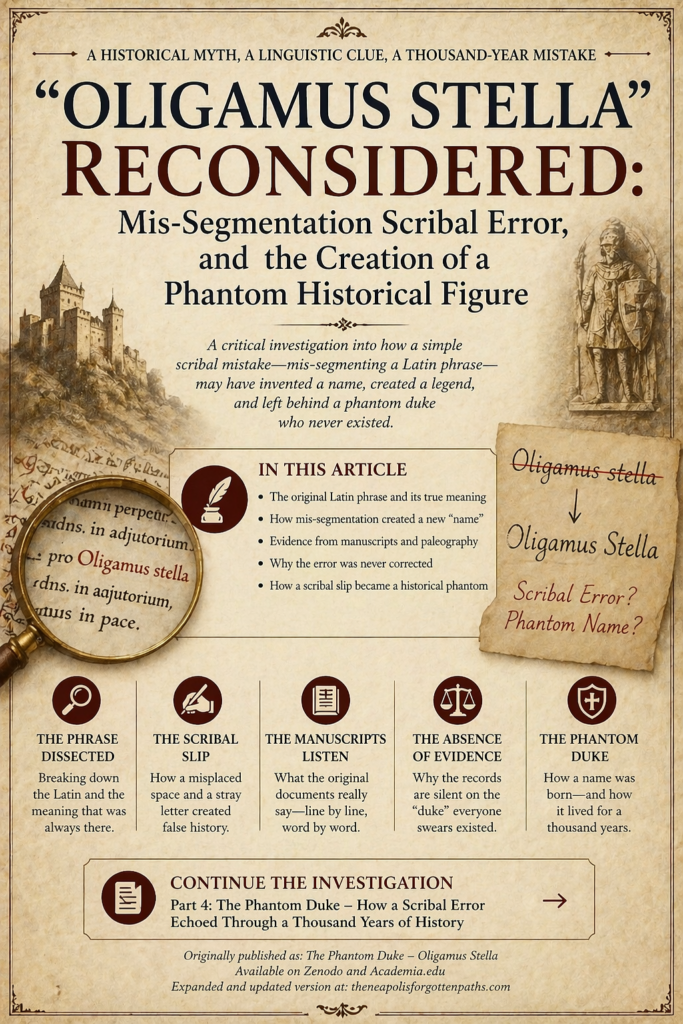
Over time this phrase, Oligamus Stella-The Phantom Duke was incorrectly split and interpreted as a personal name—creating the illusion of a figure known as “Oligamus Stella,” sometimes later described as a duke (dux), despite no historical evidence. Continue with your journey with the Oligamus Stella the Phantom Duke.
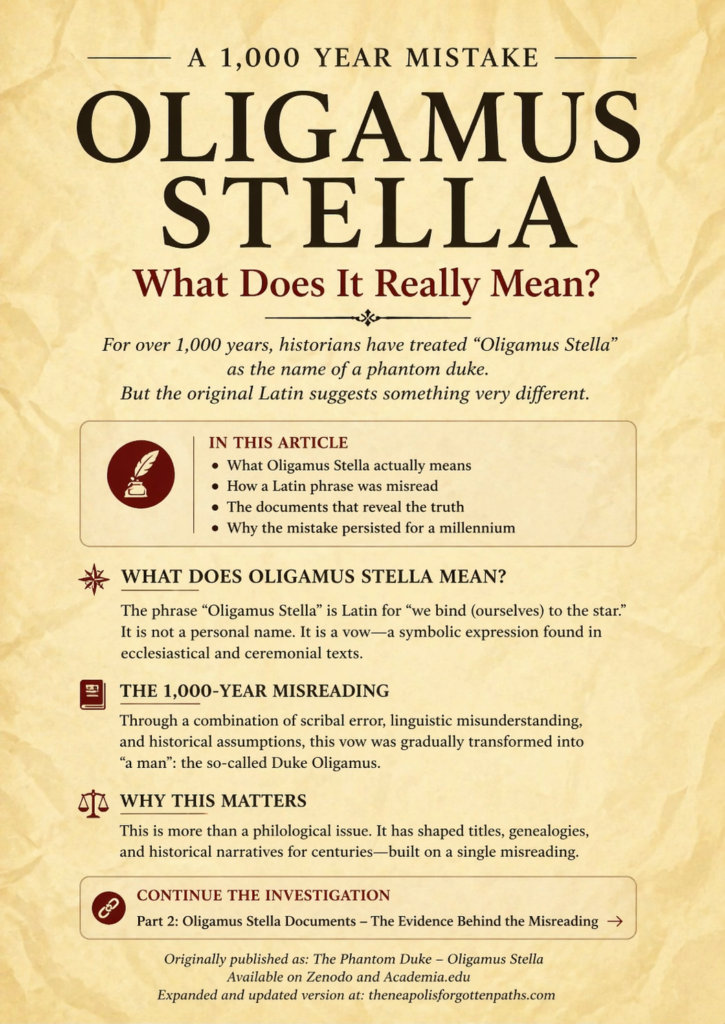
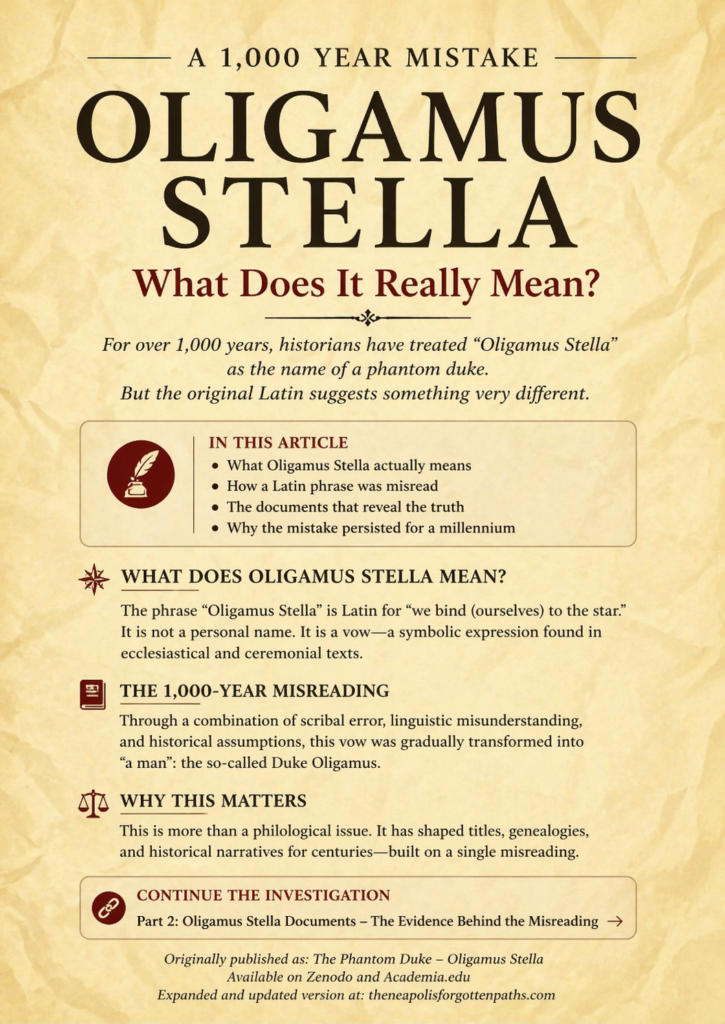
The phrase “Oligamus Stella – The Phsntom Duke” and it’s meaning has puzzled historians for centuries, often misinterpreted as the name of a medieval duke. In reality, it is most likely a misreading of the Latin nos obligamus, a phrase that was incorrectly divided and transformed into a fictional historical figure.
The Name That Never Was
Oligamus Stella has long been interpreted as a historical figure, yet closer analysis suggests the phrase may instead result from a mis-segmentation in medieval Latin, transforming a textual formula into the name of a person who never existed. By examining the language, manuscript transmission, and scribal practices behind the phrase, this study reconsiders Oligamus Stella as a phantom figure created not by history, but by error.
Section I — The Problem No One Questioned
The phrase appears in later historical traditions as if it refers to a person: Oligamus Stella, dux
From this, an identity was constructed:
A duke
A leader of consuls
A founder figure tied to noble lineages
But There Is A Problem
There is no contemporary record clearly identifying such a person.
Instead, what we find are:
Fragmented Latin phrases
Copied manuscripts
Later reinterpretations
Section II — The Mechanics of the Error
The key to the entire mystery lies in how medieval Latin was written.
In many manuscripts:
Words were written without spacing
Punctuation was minimal or nonexistent
Meaning depended on reader interpretation
A phrase like: “nos obligamus stella dux genellus capicius” could easily be misread as:
Oligamus Stella, dux Genellus Capicius
This is segmentation error, and not a translation error.
Section III — Reconstructing the Original Meaning
Let’s break the phrase correctly:
nos obligamus → “we bind ourselves” / “we are obligated”
stella → possibly a place, family marker, or symbolic identifier
dux → leader (not necessarily a formal duke)
genellus capicius → likely names within a list (Genellus / Capicius)
Instead of a single person, we now have:
A collective declaration, likely from a group such as consuls.
Section IV — Where the Illusion Took Shape
The transformation from phrase → person likely occurred centuries later.
Key figures in this shift include:
Pomponio Leto
Giovanni Antonio Summonte
Francesco Elio Marchese
These writers worked in a period where:
Manuscripts were already degraded
Context was partially lost
There was strong incentive to construct noble origins
A fragmented phrase became a named individual.
Section V — The Capece Connection
The inclusion of names like Capicius (Capece) created a powerful effect:
It linked the phrase to recognized noble families
It encouraged historians to interpret the text as genealogical evidence
This is how: A grammatical structure became a bloodline claim
Section VI — Why No One Caught It
This error persisted because it fit expectations:
Medieval historians expected leaders and founders
Genealogists sought legitimizing ancestors
Later readers trusted earlier interpretations
So the illusion reinforced itself.
Section VII — What Oligamus Really Was
When we strip away the misreading, what remains is far more interesting:
A formal Latin obligation clause
Likely tied to civic or diplomatic action
Possibly connected to famine relief negotiations
Backed by high authority (not independent consuls)
Oligamus: Not a duke. Not a founder. But a voice of obligation.
Conclusion — The Birth of a Phantom
“Oligamus Stella, dux” was never a man.
It was:
A phrase
A function
A misunderstanding
And from that misunderstanding, a phantom was born—one that would persist for centuries.
Frequently Asked Questions
What does Oligamus Stella mean? “Oligamus Stella” is not a real person, but likely a misreading of the Latin phrase nos obligamus, meaning “we bind ourselves.”
Was Oligamus Stella a real duke? No historical evidence supports the existence of a duke named Oligamus Stella.
Where did the name come from? It likely originated from a scribal misinterpretation in medieval Latin texts.
Over time, this phrase, Oligamus Stella – The Phantom Duke was incorrectly split and interpreted as a personal name—creating the illusion of a figure known as “Oligamus Stella,” sometimes later described as a duke (dux), despite no historical evidence. Continue your journey with Oligamus Stella – The Phantom Duke.
Author: Douglas Estill The Neapolis Forgotten Paths Project (2026)
The phrase “Oligamus Stella – The Phantom Duke” and it’s meaning has puzzled historians for centuries, often misinterpreted as the name of a medieval duke. In reality, it is most likely a misreading of the Latin nos obligamus, a phrase that was incorrectly divided and transformed into a fictional historical figure.
Walking the ground behind a medieval mystery
Oligamus Stella has long been regarded as a historical founder, yet the phrase may instead be the result of a medieval scribal error that created a figure who never existed. But if Stella was not a person, then where exactly was Stella?
What if “Oligamus” was never a name—but a misreading of a common Latin construction?So, the last time that we visited we were investigating the phrase “Nos Oligamus Stella, dux”. And we determined through examination of scribal errors and mis-segmentation by various authors, that the words “Nos Oligamus” was not a name but the verb phrase “nos obligamus”. When translated, meant, “we obligate or oblige”. Common language of that time for usage in legal documents.
Now, we are left with the dilemma of identifying the word, “Stella” as used in the context of the total phrase, “Nos Obligamus Stella, dux”. You’re going to need to buckle your seat belt on this one. Trust me, it’s complicated.
What will take you just a couple of minutes to read this article? It took me two and a half years of research to get to this point of writing. Whew, now that I have that out of the way, let’s start investigating the word, Stella.
Okay, I had only two avenues regarding Stella; a name or person, or a place or location. So, I started with a name or person. Research rather quickly turned out that the name of Stella didn’t show up until the year 1257 ad., under Jean-Baptiste Stella.
Okay, so now I have two disqualifiers for the name Stella. Jean-Baptiste is two hundred and fifty years too late for our narrative, and proper names with surnames didn’t really evolve until the late 11th century, and then surnames were sparsely used by the aristocracy. Alright, so now we know that Stella as a person did not exist for at least two hundred and fifty years after the time of Oligamus Stella.
Thus, Stella must be a place or location. So, I start searching for locations or places called Stella that existed around 1000 ad. I quickly learned that I had a problem. Now remember all of this started in the Naples area of Italy.
Even though you and I now know that a real person named Oligamus didn’t exist during that time frame. The authors of the 15th and 16th centuries presumed that he was real and attributed history to him.
At one point in my research, I read a segment of a manuscript that read closely to this: “Oligamo Stella/Estelle fled Naples in fear of the Roman emperor and returned to his home of Marseilles and Draguignan”.
So, the “Oligamo Stella/Estelle play develops. I need to introduce some of our supporting cast: Attanulfus(Atanulf), Pandulphus(Pandulf), Petrus(Petri), Malfredum and Bertrandus. These people play a very pivotal part in our research and investigation of the word Stella.
So, through that remnant we now have a migration from Italy to basically the area of France, known as Provence. That was very plausible because during that time in Italy, the Byzantine Greeks of the Benevento area, and the Lombards of the Capua area were being persecuted by the Roman emperor, Henry VI.
I still had a problem; I could not find a place or location called Stella. I could find all sorts of named entries with de Stella as a designator. For example: Petri de Stella, Flota de Stella, Bernardus de Stella, Malfredum de Stella. HINT: You will see those names appear again in another segment with a different role.
My question that I had to answer was if Stella was not a name, and if I can’t find a place or location called Stella; but a lot of named individuals with de Stella attached to their name. The de Stella entry must be a geographic area.
Before this gets any more confusing to you, I actually need to cite my main source for this writing: “Cartulaire de l’Abbaya de Saint-Victor de Marseilles, volumes 1 and 2”. These two volumes are some of the most complete information in regard to named individuals, aristocracy, land transfers, and yes, military security(Knights) for the various abbey and diocese properties.
Now the premise is based on the allusion that Oligamus fled Naples to arrive in Marseilles. Marseilles is a seaport and travels from Naples, itself a seaport, to Marseilles by sea is highly plausible. But how do we get from Marseille to Draguignan. And how is de Stella tied into all of this? And is Stella a lost medieval landscape in Provence?
Well, yes, it is a lost medieval landscape by name only in Provence, France. Without boring you with a litany of geographic locations; I’ll only mention the “high points” and that was a pun. Because as a geographic reference a “high point” is critical in evaluating Stella.
During the medieval age in Provence, France a signaling system was needed to be developed to warn areas that they were in danger. The areas needing information ran from Marseilles to the Draguignan(Var) region. What was developed was a system of beacons(large fires) that could be seen from miles away.
That meant that the beacons had to be placed on high ridges. With the development of the beacon system small agricultural communes developed. But with the need for the beacon warning system, an agricultural community began developing, and there was a need for water.
Here is the groundwork for that three tier system. In that area a ridge named Le Malmont was used as a beacon point. This ridge dominates the surrounding area. From there you can see the entire basin below. From there, we expand to Le Rasteou, a mid-slope platform.
Partway down, the land opens into a kind of a shelf – structured, organized, and clearly used over a very long period of time. Not quite a valley and not quite a ridge; but the kind of place that would cause people to gather and develop a community.
Moving along, we come to what is known as the valley corridor and the Argens river. This is an area where movement happens: goods are traded, people congregate, and travel routes develop. More importantly, the valley corridor(Stella Corridor) is where everything funnels through.
If you follow the terrain long enough, everything pulls toward one place: Les Arcs-sur-Argens. That’s where the crossing is. In the medieval world, crossings aren’t just convenient-they’re critical. The crossings control: trade, travel, and communication. Which means they attract: authority, conflict, and attention.
While studying ancient maps of that area, one area stood out immediately: Les Croisieres. At first glance, it seems just like any other named area. Until you break down the name: Croix(cross), Croisiere(crossing or crossroad).
It’s a place where routes meet and where something is marked. That’s not just geography. That’s function. And suddenly, the landscape wasn’t just terrain anymore. It was organized.
A charter from the Cartulary of Saint-Victor described something very specific: a dispute, a gathering of milites(knights), and a meeting inside a church. And the church’s name was Sancti Christophori.
The meat of this story involves two of our cast members. The Archbishop of Arles was asked to oversee a land dispute of a very wealthy landowner, named Isnard. Isnard summoned witnesses and compelled the appearance of local milites. The Archbishop mediated disputes involving land, rights, or feudal obligations.
Oh, and the milites(knights) that the Archbishop of Arles compelled to show up to this meeting were none other than Flota de Stella, and Malfredum de Stella and other local knights.
Why this information was important was the distance the knights had to travel. It had to be within at least a day’s journey. Now the de Stella reference begins to tighten geographically. It has to be in the Arles-Riez-Frejus sphere, which keeps us tightly in the Draguignan corridor.
Conclusion: Can I drop a pin in Google maps and definitively say: This is the location of Stella, no. Stella is a toponym describing a geographical area functioning within a medieval system.
If the area of Stella is real, and it is. It’s called the “Stella Corridor”. Then who were the men that controlled it?
From Phantom Identity to Institutional Reality
The case of “Oligamus Stella” demonstrates how a textual error can generate the illusion of a historical individual. But this phenomenon raises a broader question: how did medieval societies distinguish between constructed identity and functional reality?
If a misreading could produce a phantom duke, then the inverse must also be considered—how repeated language, shared roles, and collective obligation could produce identities that were very real, even if they began as abstract concepts.
One such example emerges in the concept of the Miles Christi, or “Soldier of Christ.” Unlike the phantom figure of Oligamus Stella, this identity was not the result of error, but of convergence—where language, belief, and social function aligned to create a new and enduring form of medieval identity.
Frequently Asked Questions
What does Oligamus Stella mean? “Oligamus Stella” is not a real person, but likely a misreading of the Latin phrase nos obligamus, meaning “we bind ourselves.”
Was Oligamus Stella a real duke? No historical evidence supports the existence of a duke named Oligamus Stella.
Where did the name come from? It likely originated from a scribal misinterpretation in medieval Latin texts.
Related Articles in the Oligamus Stella – The Phantom Duke Investigation
Over time, this phrase was incorrectly split and interpreted as a personal name—creating the illusion of a figure known as “Oligamus Stella,” sometimes later described as a duke (dux), despite no historical evidence. Continue with your journey with the Oligamus Stella the Phantom Duke.
Over time, this phrase, Oligamus Stella – The Phantom Duke was incorrectly split and interpreted as a personal name—creating the illusion of a figure known as “Oligamus Stella,” sometimes later described as a duke (dux), despite no historical evidence. Continue with your journey with the Oligamus Stella the Phantom Duke.
Oligamus Stella –The Phantom Duke: Born from a Misreading
Introduction:
The phrase “Oligamus Stella” meaning has puzzled historians for centuries, often misinterpreted as the name of a medieval duke. In reality, it is most likely a misreading of the Latin nos obligamus, a phrase that was incorrectly divided and transformed into a fictional historical figure.
This article has been in the making for several years. The first time I saw the name “Oligamus Stella,” it was linked in a book that was written by J.H. Estill in a 1903 publication entitled, “The Forgotten Books”. It was an interesting read on the Stella/Estelle/Estill lineage. Sometime after that, I read a publication from 1943 written by Alma Lackey. Her writing was was also entitled “The Forgotten Books”, which was basically an extension of J.H. Estill’s work. Albeit, she was able to include a better and more extensive description of the Estill’s and their historical roles they played in America.
They were able to provide limited information for the d’Estelle/Estelle individuals in Europe during the 15th and 16th centuries, and a historical blip listing an Oligamus Stella/Estelle.
That name of Oligamus Stella, started a period of research. When I would do an internet search the recurring phrase across numerous manuscripts from Naples would simply record: “Nos Oligamus Stella, dux”.
I’ll admit, I got really excited! I thought, I’m related to an honest to goodness Duke of Naples. So, begins the research for Duke Oligamus Stella. Thankfully, I am able to read and translate Latin manuscripts. I read thousands of pages in various books written by exemplary historians.
This story starts with the Italian historian and humanist, Giulio Pomponio Leto. His life was from 1428 – 1498 ad. He was a prolific teacher and scholar. He wrote, “De antiquitatibus urbis Romae libellus” and “De magistratibus”.
From Leto we now turn to another humanist that he was associated with, “Pietro Summonte”. Summonte lived from (1436 – 1526 ad). Summonte was renowned for his roles in preserving and disseminating the works of fellow scholars and humanists of that era.
The third culprit in the Oligamo Stella saga, is Francesco Elio Marchese. Marchese was born in the first half of the 15th century. In Naples, Italy it has been noted that he frequented various cultural circles, coming in contact with various personalities such as Pomponio Leto.
So now, we have all the players listed that contributed to the “Nos Oligamus Stella, dux story”. Let’s add to the mix the books and manuscripts that contributed to the saga: 1.) Raccolta di tutti i piu rinomati scrittori dell’ regno di Napoli 2.) Memorie Cronologighe De’ Vescove 3.) La Nobilita di Napoli 4.) Origene De’ Cognomi Gentilizg Nel Regno Di Napoli.
By now, I am really excited. I have numerous highly esteemed historians and a multitiude of publications mentioning, “Nos Oligamus Stella, dux”. I thought that I had hit pay dirt and found a regal link to the Estill family. Yeah, don’t get too far ahead in the story. Here is how the narrative of “Nos Oligamus Stella, dux took shape.
The premise here is Marchese is supporting a claim that had previously been reported by Pietro Summonte that Pomponio Leto had shown him a fragment of parchment that had been written in Longobarde script mentioning Oligamus and the consuls in 1009 ad.
Now follows the curious parts. Almost verbatim across every book and manuscript that I read about Oligamus and the consuls was recorded the same, even though the authors of many of these books did not live in the same centuries.
So, at that point, I cast a wide net trying to find Oligamus Stella listed independent of the consuls. I searched Byzantine records, the abbeys of Benevento and surrounding areas. The time that I had invested at that point in this research was about year and a half. I could not break the glass ceiling regarding Oligamus.
I had read other historians of the 15th and 16 th century that were doubting that Oligamus was an actual Duke of Naples. And in some respect they were right. If you examine the Dukes of Naples you will not find him listed. Well, it was at this point that life got in the way of my research and the project got shelved for several years.
Two and half years past until I picked up these dusty papers and started re-reading my notes. My mind went back to the time of the research. What went wrong, where did Oligamus go, why can’t I find him listed anywhere else other than that with the consuls. It didn’t make sense if he was a real Duke his name would be plastered all over manuscripts of that era.
Oligamus Stella, dux: It had all the right ingredients, it sounded early, it sounded rare, and it carried just enough mystery to feel important. If you’re doing genealogical or historical work, that’s the kind of name you want to find. When you find a legitimate historical figure, they tend to leave a trail. They show up in multiple records. Their name appears in slightly different forms. They connect to other known people. “Oligamus Stella” did none of that. It just… sat there; no supporting appearances; no variation; no context that made him feel real.
That’s when I stopped asking and started investigating. But the longer I stared at “Nos Oligamus Stella, dux”, the more something felt… off. Grammatically the phrase just didn’t behave like a real person. Syntax wise the Latin wasn’t written cohesively. It was jumbled and the verb and modifiers were all in the wrong place.
———————————————————————————————————–
The Moment Things Started to Unravel:
“What is this line actually saying?” Medieval Latin isn’t like what we’re used to reading. There’s: no punctuation, very little spacing and a heavy use of abbreviations. In other words, you’re not just reading—you’re interpreting structure. And structure can trick you. At one point, I went back and looked at the line again—not as a name, but as a sentence. That’s when something jumped out. – The “word” that changes everything.
I remember one afternoon scouring over pages of manuscripts. It was one of those time consuming and laborious tasks. Typically manuscripts written in Latin do not capitalize proper names. So you read and translate each word in a sentence very slowly so that you don’t skip over something important. That’s when I had my Eureka moment. There it was, buried mid-sentence in the middle of a page. The word was “obligamus”, a very common legal phrase in medieval documents: The phase, “nos obligamus”, means “we bind ourselves” or “we obligate ourselves.” You see it all over charters. It’s boilerplate language.
Now here’s where things get interesting. If you take into account the writing styles during the 15th and 16th centuries, if you remove spacing—or shift it slightly—you get: obligamus → oligamus. And suddenly, a verb becomes a name. When a sentence turns into a person.
Once I saw that, I couldn’t unsee it. What looked like: “Oligamus Stella”, started to look more like: “nos obligamus … [something involving] stella”. In other words: “oligamus” wasn’t a person, it was part of a legal action. And “Stella”? It was likely: a place, a descriptor, or part of a separate clause, …but it had been pulled into the wrong spot.
In another part of the Oligamus Trilogy, we’ll show how Stella actually comes into play. How the Phantom Founder Is Created:
Here’s the part that really matters. Once a phrase gets misread as a name, it takes on a life of its own. Especially if: it looks old, it looks rare, and it fills a gap people want to fill. From there, it’s a short leap to: “This must be an ancestor.” And once that idea gets written down—even once—it starts to stick. Not because it’s correct, but because it’s convenient.
Remember earlier that I mentioned Elio Marchese. Not only was he a prolific author and historian, but he was also the family writer for the Capece lineage. Based on the timeline of 1009 attributed to Oligamo and the consuls, the Capece family was still living in Sorrento. The Capece family is an ancient Italian noble house originating from Sorrento around 1040, renowned for its extensive feudal holdings, military service to medieval monarchs, and enduring patrician status in Naples and southern Italy.[1]
Emerging under the Norman and Swabian dynasties, the family—originally known as Cacapece—relocated to Naples during the reign of King Manfred of Sicily (1258–1266), where members like Marino Capece, brother of the Viceroy of Sicily Corrado Capece, played key roles in royal administration and defense.[1]
Their loyalty to the Swabian cause led to persecution and exile by the Angevin conquerors following the 1268 Battle of Tagliacozzo, with many fleeing to Dalmatia, Sicily, and back to Sorrento; reconciliation with the Angevins in the late 13th century allowed their return, restoration of wealth, and accumulation of baronies.[1]
During that period of time, it was very important for families who wanted to elevate to an aristocratic level to align themselves with an ancient noble. The Capece family was no different, they wanted to be one of the seven seats of Capua in Naples. And if you read the manuscripts, the Capece family align themselves with Oligamus and the consuls, who pre-date their arrival by several hundred years.
As a family historian for the Capece family, Marchese did an effective job of inserting the Oligamus saga into their narrative. From that point on, later humanist writers considered what Marchese wrote about the Oligamus story as being authentic. Why would any author during the middle ages doubt the writings of a Leto, Summonte, Marchese, or a Borelli. And the story took on a life of it’s own and became accepted as truth.
But, when you go back to the manuscripts themselves, the problem becomes obvious. They’re dense. they’re continuous, and they don’t give you clean boundaries between words. In an 11th century Beneventan or early Caroline miniscule manuscript, this is how the Nos Oligamus Stella, dux would have looked like: “nosoligamusstelladux”. When you look at text like this, you realize something important. The reader is doing as much work as the writer. And if the reader expects to see a name…they often will. So What Happened? At some point, someone: read a compressed Latin phrase; mis-segmented a word (obligamus → oligamus); and attached “Stella” to it. Then treated the result as a person. From there, the name: gets copied, gets repeated, and eventually starts to look legitimate.
———————————————————————————————————–
Why This Matters:
This isn’t just about one name. If “Oligamus Stella” isn’t a real person, then: we may be chasing the wrong origin. We may be building stories on top of a misreading and we may be overlooking the actual people in the record. And that’s the part that really bothered me. Because if this isn’t a person…then something else is hiding in plain sight. At first glance, the question “Where is Stella?” appears to be a straightforward matter of geography. But this assumption depends entirely on whether Stella was ever a place to begin with.
Once I let go of “Oligamus Stella” as a real individual, everything shifted. The question stopped being: “Who is he?” …and became: “What system, place, or people were being described here instead?” That’s where things started to get interesting.
Frequently Asked Questions
What does Oligamus Stella mean? “Oligamus Stella” is not a real person, but likely a misreading of the Latin phrase nos obligamus, meaning “we bind ourselves.”
Was Oligamus Stella a real duke? No historical evidence supports the existence of a duke named Oligamus Stella.
Where did the name come from? It likely originated from a scribal misinterpretation in medieval Latin texts.
The meaning of the phrase “Oligamus Stella – The Phantom Duke” is most likely the result of a medieval scribal misreading of the Latin expression nos obligamus (“we bind ourselves” or “we commit”). Over time, this phrase was incorrectly split and interpreted as a personal name—creating the illusion of a figure known as “Oligamus Stella,” sometimes later described as a duke (dux), despite no historical evidence. Continue with your journey with the Oligamus Stella the Phantom Duke.
Likely derived from Latin: obligamus (“we bind / we commit”)
Oligamus Stella Meaning: What the Phrase Really Says:
In medieval Latin documents, phrases like nos obligamus (“we bind ourselves”) were commonly used in legal, civic, and ecclesiastical agreements. These expressions appear in charters, oaths, and formal declarations, particularly when groups such as consuls or witnesses collectively affirmed an obligation.
The term “Oligamus” is best understood as a corrupted form of obligamus, produced through copying errors or later transcription. Rather than identifying an individual, the phrase originally functioned as part of a formal statement of commitment.
The Latin Phrase “Nos Obligamus” Explained:
Medieval manuscripts were often written without consistent spacing between words, making them vulnerable to misreading. A phrase such as:
nos obligamus stella…
could easily be misinterpreted by a later reader unfamiliar with the formula. Over time, this mis-segmentation transformed the phrase into:
Oligamus Stella – The Phantom Duke
Once separated and capitalized, it began to appear as a proper name rather than a verb phrase. Later historians and compilers, encountering the phrase out of context, interpreted it as referring to a person—sometimes even assigning the title dux (duke), further reinforcing the illusion of a historical figure.
Is Oligamus Stella a Real Person?
No—there is no independent historical evidence that “Oligamus Stella” was a real individual. The name does not appear in reliable genealogical records, consistent naming patterns, or corroborated historical accounts.
Instead, the phrase is best understood as a linguistic artifact: a misinterpreted fragment of a Latin obligation formula that was gradually transformed into a supposed identity.
Frequently Asked Questions
What does “Oligamus Stella” mean?
“Oligamus Stella” is most likely a misread Latin phrase derived from nos obligamus, meaning “we bind ourselves” or “we commit,” not the name of a real person.
Was Oligamus Stella a real duke?
No. There is no credible historical evidence that such a person existed. The title dux appears to have been attached later through misinterpretation.
What is the origin of the phrase?
The phrase likely originates from medieval Latin legal or civic formulas, where obligamus was used to express collective obligation or agreement.
“Oligamus Stella” is not a forgotten duke—it is a linguistic error that reshaped history.
Frequently Asked Questions
What does Oligamus Stella mean? “Oligamus Stella” is not a real person, but likely a misreading of the Latin phrase nos obligamus, meaning “we bind ourselves.”
Was Oligamus Stella a real duke? No historical evidence supports the existence of a duke named Oligamus Stella.
Where did the name come from? It likely originated from a scribal misinterpretation in medieval Latin texts.
Related Articles in the Oligamus Stella – The Phantom Duke Investigation: