Category: Miles Christi

  • Before the Templars: The Emergence of the Miles Christi as an Operational Identity

    To view all of our investigative articles, please use our Directory Portal

    A more descript academic reading is available at: Zenodo.org

    Author: Douglas Estill

    The Neapolis Forgotten Paths Project (2026)

    Miles Christi: Was It Just A Metaphor

    Introduction — The Problem
    Historians treat miles Christi as a metaphor


    The term miles Christi occupies a central position in the intellectual and spiritual history of medieval Christianity. Yet its functional meaning remains curiously underdefined. Was it merely metaphor, or did it operate as a lived identity prior to the institutionalization of military orders?

    Thesis
    This study argues that milites Christi functioned as a contemporaneous and operational identity during the late eleventh century, emerging through the convergence of ecclesiastical reform rhetoric and crusading military practice, prior to its later institutionalization.

    ———————————————————————————————————–

    II. Historiography — What Others Got Wrong (or Missed)
    A. The “Metaphor Only” Model

    Augustine of Hippo viewed the miles Christi (soldier of Christ) primarily as a spiritual
    concept, reframing the Roman soldier’s oath and duty into a baptismal vow to combat sin, the
    world, and the devil. This concept emphasized inner spiritual struggle, obedience to Christ, and
    the sacrifice of personal will, laying the groundwork for later medieval interpretations.
    Key aspects of Augustine’s concept of miles Christi:

    • Baptismal Commitment: Augustine viewed baptism as the moment a believer takes
      the sacramentum (oath) to become a soldier in Christ’s service, renouncing evil and
      committing to a life of devotion.
    • Spiritual Warfare: The “battle” is internal, involving the struggle for virtue over vice, rather than literal military conflict.
    • Foundation for Just War: Augustine’s theological work, particularly on interpreting duty, was later used to justify the merging of spiritual and physical warfare in just war theory and the crusading ideals of the milites Christi (knights of Christ).
    • Inner Transformation: The miles Christi must fight the selfish “thirst for human
      pleasures” and align their will with God, often requiring intense self-discipline.
      While the concept was adapted later to describe military orders, Augustine’s focus was on the internal battle of faith and spiritual devotion to the “Lord”.
    • ——————————————————————————————————-

    B. The “Crusade Explosion” Model

    A second prevailing interpretation situates the emergence of the milites Christi squarely within the context of the First Crusade, treating the term as a product of crusading rhetoric and mass mobilization. In this view, the identity of the “soldier of Christ” appears suddenly, driven by the ideological needs of papal preaching and the narrative framing of crusade chroniclers. The phrase is thus understood primarily as propagandistic language, employed to sacralize warfare and motivate participants.

    While this model recognizes the importance of crusading discourse, it tends to assume that the term’s functional meaning originates fully formed within that environment. The evidence examined here suggests a more nuanced development.

    A representative example may be found in the chronicle of Petrus Tudebodus, where the phrase appears in an explicitly operational context:

    “…quomodo Christi militibus nocere potuissent.”

    In this passage, opposing forces are described as observing and preparing to harm the Christi milites. The term is not presented as a rhetorical flourish or a device of exhortation, but as a designation for an identifiable group of combatants within an ongoing tactical situation. The narrative does not introduce or explain the phrase, implying that its meaning is already intelligible within the framework of the campaign.

    Further evidence in the same source reinforces this interpretation. The figure of Tancred is described as:

    “…prudens atque honorabilis Christi miles…”

    Here, the designation is applied to a living commander actively engaged in military operations.
    This usage extends beyond collective rhetoric and demonstrates that miles Christi functions as an individual identity attributed within the flow of events, rather than as a retrospective or purely symbolic label.

    These examples complicate the “Crusade Explosion” model. Rather than emerging suddenly as rhetorical propaganda, the term appears embedded within the practical language of warfare, applied to both groups and individuals without explanatory framing. This suggests that the concept of the milites Christi was already sufficiently developed to function as a recognized and operational identity during the course of the campaign itself.(1)

    ———————————————————————————————————–

    C. The “Institutional Model”

    A third line of interpretation locates the emergence of the miles Christi within the rise of formal religious-military institutions, particularly in the early twelfth century. In this model, the identity of the “soldier of Christ” is understood to take coherent form only with the establishment of organized orders—most notably the Knights Templar—and its subsequent theological articulation by figures such as Bernard of Clairvaux in De Laude Novae Militiae. From this perspective, the term acquires practical meaning through rule, vow, and institutional structure;
    prior usages are treated as either metaphorical or insufficiently defined.

    While this framework successfully explains the later stabilization and formalization of the concept, it risks projecting institutional coherence backward onto a period in which no such structures yet existed. The narrative evidence from the First Crusade suggests that the identity of the milites Christi was already functioning in a practical sense before its codification within religious orders.

    A representative example appears in the chronicle of Petrus Tudebodus. In describing
    reconnaissance and impending engagement, the text notes:

    “…quomodo Christi militibus nocere potuissent.”

    Here, the Christi milites are presented as a distinct group of combatants within an active tactical scenario, sufficiently defined to be the target of enemy planning. No institutional framework is invoked; the designation operates without reference to rule, vow, or corporate organization.

    The same narrative applies the term at the level of individual identity:

    “Tancredus… prudens atque honorabilis Christi miles…”

    Tancred, an active commander within the expedition, is identified as a Christi miles in the midst of ongoing operations. This attribution is neither ceremonial nor retrospective.

    It reflects a contemporaneous identity embedded within the conduct of warfare, independent of formal institutional affiliation.
    Taken together, these passages indicate that the concept of the milites Christi was already operationally meaningful prior to its institutionalization. The later emergence of organized orders, therefore, should be understood not as the origin of the identity, but as its formal consolidation and regulation. The “Institutional Model,” while valuable for explaining the twelfth-century stabilization of the concept, does not fully account for its earlier existence as a lived and functional designation within the context of crusading activity.

    Existing interpretations have tended to isolate the term, “Miles Christi” within either theological abstraction or institutional formalization, leaving its transitional development insufficiently explored.

    ———————————————————————————————————–

    III. The Prehistory — Spiritual Militia Christi

    The expression militia Christi possesses a well-established prehistory within early and early medieval Christian thought, where it functions primarily as a metaphor for spiritual struggle. In patristic and monastic contexts, the language of warfare is consistently internalized: the Christian is cast as a soldier engaged not against human enemies, but against sin, temptation, and the forces of evil. This usage provides the conceptual vocabulary that later developments will draw upon, but it does not yet correspond to a literal or operational military identity. A representative example may be found in the Pauline tradition as interpreted by early
    commentators such as Ambrosiaster.(4)

    In discussing 2 Corinthians 10:4, the text emphasizes:

    “arma enim militiae nostrae non carnalia sunt…”
    (“for the weapons of our warfare are not carnal…”)

    Here, the language of militia and arma is explicitly detached from physical combat. The “weapons” in question are spiritual—faith, discipline, and obedience—directed toward the subjugation of vice rather than the defeat of a human opponent. The soldier of Christ, in this framework, is defined by ascetic endurance and moral resistance, not by participation in organized violence.

    This interpretive tradition persists throughout the early medieval period, appearing in monastic literature, biblical exegesis, and pastoral instruction. In such contexts, militia Christi denotes a condition of spiritual discipline and allegiance, applicable to clergy and laity alike. Crucially, it lacks any consistent association with battlefield activity, command structure, or collective military organization.

    The significance of this prehistory lies not in its continuity with later developments, but in its difference. The spiritual militia Christi establishes the symbolic and linguistic foundation upon which subsequent transformations will build. However, as the evidence from eleventh-century sources demonstrates, the term undergoes a profound shift when applied to armed actors within the context of crusading warfare. The transition from metaphorical to operational usage cannot
    be understood without first recognizing that the original framework was explicitly non-military
    in its orientation.

    Key points:

    • early Church usage
    • metaphorical combat
    • monks, ascetics

    While this early usage establishes the conceptual vocabulary, it does not account for the term’s later application to armed actors within historical narrative.

    ———————————————————————————————————–

    IV. Reform Era Shift — Gregory VII and Mobilized Christianity

    The transition from the spiritual militia Christi of earlier Christian tradition to its later application within martial contexts does not occur abruptly with the First Crusade. Rather, it is prepared within the rhetoric and policy of the reform papacy in the later eleventh century, most notably under Gregory VII (r. 1073–1085). In this period, the language of Christian service begins to move beyond interior discipline toward collective, outwardly directed action, particularly in the defense of the Church.

    Gregory’s correspondence preserves this shift in formation. In addressing the dangers facing Christendom and the need for unified response, he invokes the concept of a strengthened Christian “militia”:

    “…contra tanta pericula fortiores in militia Christi…”(5)

    Here, the phrase militia Christi retains its inherited religious resonance, yet its context has changed significantly. The concern is no longer solely moral or ascetic struggle, but the confrontation of external threats (pericula) facing the Christian community. The “militia of Christ” is thus framed as something that can be collectively reinforced, implying not merely individual devotion but organized response.

    This development is further evident in Gregory’s appeals for coordinated action in defense of the Church and its interests. His rhetoric consistently links fidelity to Christ with the willingness to act in protection of ecclesiastical order. Although the terminology stops short of explicitly identifying armed individuals as milites Christi, it establishes a crucial conceptual bridge:

    • Christian service (militia)
    • collective obligation
    • externalized threat
    • and the legitimacy of action in response

    In this sense, Gregory’s usage represents a transitional stage. The militia Christi is no longer confined to the internal sphere of spiritual struggle, yet it has not fully crystallized into the operational identity later observed in crusading narratives. Instead, it occupies an intermediate position in which the language of sacred service is being reoriented toward the defense of the Church as a lived, communal responsibility.

    This shift is decisive. By reframing Christian obligation in terms that accommodate organized, outward action, the reform papacy provides the conceptual conditions necessary for the later emergence of the milites Christi as an identifiable class of armed actors. The crusading sources do not create this identity ex nihilo; rather, they activate and apply a framework already in motion.

    Key framing line:

    In the rhetoric of the reform papacy, the militia Christi begins to move from inward discipline
    toward outward defense, establishing the conceptual conditions for later militarization.

    ———————————————————————————————————–

    Gregory VII — External Threat Language

    “…contra tanta pericula fortiores in militia Christi…”

    • pericula = dangers/threats
    • not internal sin
    • not ascetic struggle

    This is already externalized Christianity
    The reference to pericula shifts the frame of Christian struggle from interior moral discipline to confrontation with external threats, signaling a reorientation of the militia Christi toward collective defense.

    ———————————————————————————————————–

    Collective Strength Language
    Same phrase: fortiores in militia Christi (“stronger in the militia of Christ”)
    This is NOT

    • individual piety
    • monk-level discipline

    The emphasis on becoming “stronger” within the militia Christi implies not merely individual devotion, but the consolidation of a collective body capable of coordinated action.

    ———————————————————————————————————–

    V. Crusade Narratives — The Fusion Begins

    The conceptual reorientation of the militia Christi in the reform era finds concrete expression in the narrative sources of the First Crusade. Within these texts, the previously distinct spheres of spiritual vocabulary and military practice begin to converge. Crucially, this fusion is not introduced as a novelty requiring explanation; rather, it appears as an already intelligible framework through which events are described.

    A preliminary stage of this convergence may be observed in the chronicle of Raymond of Aguilers. In recounting episodes of combat and exhortation, the narrative juxtaposes martial activity with explicitly Christ-centered authority. Soldiers are urged to engage the enemy, while their leaders are framed in relation to Christ’s authority, at times described as acting under or in the manner of a vicarius Christi. The terminology of milites and the language of divine purpose coexist, yet are not consistently fused into a single fixed expression.(6)

    This stage is significant because it demonstrates that the idea precedes the stabilized phrase. The participants are already understood as fighting within a sacred framework, even where the explicit designation milites Christi is not yet systematically applied.

    A more advanced stage appears in the writings of Hugh of Fleury, where the terminology begins to solidify. In describing the actions of crusading forces, references to milites Christi are explicitly linked to engagement with enemies:

    “…milites Christi… hostes…”

    ———————————————————————————————————–

    Here, the phrase moves beyond conceptual alignment and becomes a descriptive label applied to armed participants within the narrative of conflict. The fusion of identity and action is now linguistically expressed. The development reaches a more explicit form in the chronicle of Petrus Tudebodus, where the phrase is deployed within direct address:

    “O fortissimi milites Christi… ecce bellum…”

    In this context, the designation functions not as retrospective commentary, but as immediate identification in a pre-battle setting. The individuals addressed are organized combatants preparing for engagement, and the term milites Christi is used to define them in that moment. The rhetorical function here is inseparable from the operational reality: the language both reflects and reinforces the identity of the group as they enter into battle.
    ———————————————————————————————————–

    Further passages within the same narrative extend this usage across multiple contexts. The term appears in descriptions of enemy intent:

    “…quomodo Christi militibus nocere potuissent.”

    as well as in the characterization of individual leaders:
    “Tancredus… prudens atque honorabilis Christi miles…”

    Taken together, these examples demonstrate that the fusion of martial and religious identity is no longer partial or situational. Instead, it operates across:

    • collective designation
    • individual attribution
    • direct exhortation
    • and narrative description of combat

    ———————————————————————————————————–

    The significance of these sources lies in their lack of explanatory framing. The term milites Christi is not introduced as a new or contested idea; it is used as though its meaning were already understood. This suggests that by the time of these narratives, the conceptual groundwork established in the reform era had matured into a functionally coherent identity. Thus, the crusade narratives do not represent the sudden creation of the milites Christi, but rather the point at which the fusion of spiritual and military frameworks becomes fully visible within the historical record.

    ———————————————————————————————————–
    Key line:
    The ideological fusion of warfare and religious purpose appears in narrative sources prior to the consistent deployment of the term milites Christi, indicating that conceptual transformation preceded linguistic standardization.

    ———————————————————————————————————–

    VI. CORE SECTION — The Operational Identity of the Miles Christi

    The preceding sections have traced the conceptual development of the militia Christi from spiritual metaphor to mobilized rhetoric. The crucial question remains whether, in the context of the First Crusade, this language functioned merely as exhortation or whether it operated as a lived and actionable identity. The narrative evidence demonstrates the latter.

    Within crusading sources, the term milites Christi is applied across multiple operational contexts,collective,individual,command,and enemy interaction—indicating its use as a contemporaneous category of identity within active warfare.

    ———————————————————————————————————–

    A. Collective Identity in Active Combat

    A defining example appears in the chronicle of Petrus Tudebodus, where enemy forces are described as preparing engagement:

    “…quomodo Christi militibus nocere potuissent.”(7)
    (“…how they might harm the soldiers of Christ.”)

    This passage situates the Christi milites within a tactical environment. The phrase is not employed as praise or retrospective commemoration, but as a designation for a targeted group of combatants. Its use within the logic of enemy planning demonstrates that the identity operates at the level of battlefield reality.

    ———————————————————————————————————–

    B. Individual Identity Applied to Leadership

    The same narrative applies the designation to a named commander:

    “Tancredus… prudens atque honorabilis Christi miles…”(8)
    (“Tancred… a prudent and honorable soldier of Christ…”)

    Here, Christi miles is not a symbolic or posthumous title. Tancred is an active participant and leader within the campaign. The attribution indicates that the identity extends beyond collective rhetoric to function as a personal designation carried by individuals in command roles.

    ———————————————————————————————————–

    C. Integration Within Command and Military Structure

    Elsewhere in the narrative, crusading forces are organized and deployed in explicitly military terms:

    “Milites tenuerunt plana, et pedites montanea…(9)
    (“The soldiers held the plains, and the footmen the mountains…”)

    “…Boamundus… praecepit omnibus…”
    (“Bohemond… gave orders to all…”)

    These passages demonstrate a fully developed command structure and tactical organization. Crucially, the same individuals identified here as milites are elsewhere described as milites Christi. This overlap indicates that the latter term does not replace military identity but redefines it within a religious framework, integrating function and meaning.

    ———————————————————————————————————–

    D. Identity in Direct Exhortation

    The operational nature of the term is further confirmed in moments of direct address:

    “O fortissimi milites Christi… ecce bellum…”(10)
    (“O most valiant soldiers of Christ… behold the battle…”)

    In this context, the phrase is used immediately prior to engagement. It serves both as identification and motivation, but its force derives from its application to real combatants preparing for battle. The identity is invoked at the moment of action, not constructed after it.

    ———————————————————————————————————–

    E. Continuity Across the Lifecycle of the Crusader

    The designation milites Christi persists beyond combat into the representation of suffering and death:

    “…Christi milites…” (in contexts of capture, execution, and martyrdom)

    This continuity demonstrates that the identity encompasses:

    • participation in battle
    • endurance under captivity

    The term therefore operates not as an isolated descriptor, but as a comprehensive identity spanning the full experience of the crusader.(11)

    ———————————————————————————————————–

    F. Recognition Within the Logic of Conflict

    The use of Christi milites within descriptions of enemy action indicates that the identity functions within the broader narrative structure of the conflict itself.

    It is not confined to internal Christian discourse but appears in contexts where opposing forces anticipate engagement with a defined group.

    This suggests that milites Christi functioned as a coherent and actionable category within the representation of warfare, rather than as a purely theological construct.

    ———————————————————————————————————–

    VII. Conclusion: Identity as Function

    The milites Christi did not emerge suddenly as an institutional category, nor remain confined to metaphorical theology. Instead, it developed as a lived identity within the context of late eleventh-century warfare, integrating spiritual purpose and military function before being formalized in the structures of later religious orders.

    Taken together, these examples demonstrate that the milites Christi are not merely:

    • rhetorical figures
    • spiritual metaphors
    • or retrospective honors

    Instead, they constitute: a contemporaneous and operational identity applied to living combatants, integrated into command structures, invoked in battle, and sustained through the full narrative arc of crusading experience.

    The fusion of military and religious identity is therefore not abstract or symbolic, but practically enacted within the conduct of war itself.

    ———————————————————————————————————–

    Footnotes

    1. Petrus Tudebodus, Historia de Hierosolymitano itinere, in Recueil des historiens des
      croisades: Historiens occidentaux, vol. 3 (Paris, 1866), [page].
    2. Bernard of Clairvaux, De Laude Novae Militiae, in Patrologia Latina, vol. 182.
    3. Ambrosiaster, Commentaria, PL 17, col. [insert].
    4. Gregory VII, Registrum, PL 148, col. [insert].
    1. Raymond of Aguilers, Historia, RHC Occ. 3, [page].
    2. Petrus Tudebodus, Historia, [page].
    3. Ibid.
    4. Ibid.
    5. Ibid.
    6. Ibid.

    ———————————————————————————————————–
    BIBLIOGRAPHY

    • Ambrosiaster. Commentaria in Epistulas Pauli. Patrologia Latina, vol. 17.
    • Bernard of Clairvaux. De Laude Novae Militiae. Patrologia Latina, vol. 182.
    • Gregory VII. Registrum. Patrologia Latina, vol. 148.
    • Raymond of Aguilers. Historia Francorum qui ceperunt Jerusalem. RHC Occ. 3.
    • Petrus Tudebodus. Historia de Hierosolymitano itinere. RHC Occ. 3.

    Our next available investigative article is: Oligamus Stella, to continue reading, please use our Directory.

  • The Rise of the Miles Christi (c. 900-1100)

    To view all of our investigative articles, please use our discovery portal.

    The full academic version of this article is available at Zenodo.org

    Author: Douglas Estill

    The Neapolis Forgotten Paths Project (2026)

    Military Religious Orders In The Early Twelfth Century

    There’s a story most people believe about the Knights Templar.

    But that story is wrong. The truth is far more interesting—and far more dangerous.

    A World Out of Control

    By the late 900s, Europe was breaking apart.

    The old order of Charlemagne was gone. Kings were weak. Authority was scattered. And violence? It was everywhere.

    Knights—armed, trained, and largely unchecked—fought constantly. Sometimes for land. Sometimes for power. Sometimes for no reason at all.

    The Church’s Gamble

    Instead of trying to stop violence, the Church did something far more radical.

    It tried to control it.

    Through movements like the Peace of God and the Truce of God, church leaders began setting boundaries:

    • Don’t attack the defenseless
    • Don’t fight on holy days
    • Don’t violate sacred ground

    It didn’t end the violence. But it changed something critical. For the first time, violence was being redefined.

    Not all fighting was evil anymore. Some of it… could be justified.


    Provence: Where Everything Changed

    Nowhere was this transformation clearer than in southern France.

    In the rugged hills of Provence, a long-standing threat had taken root—a fortified base known as Fraxinetum.

    From there, raiders struck deep into Christian lands. For decades, they controlled the region. Until one man changed everything.


    The Fall of Fraxinetum

    https://images.openai.com/static-rsc-4/xdCFOCvzna_2QAOP8P-l8Uo9FsXG-1n_ewKp8BNqEeDhFCU9k6kdXizhIXXB0QdvN3UXb32ufCVaKshLYFLShxj83BeT1oGV7I8k0wlyoPfk7Oigemd4OrsnzVaetFT5R9LJ-naaC1C5g5IjPAj4pICGpcfB_dgiwGBxFeKn2NFLKAFMPhI4T5egVlB9xtHv?purpose=fullsize
    https://images.openai.com/static-rsc-4/rUjHtKqjZIlKXNeO36uwhJGLSzhUYOyQ7BAj_knlg0RGpz799WHddW8jX125wbx7ivi4eWiiqXKYZJHL7CQcK08itQXnDvjolbXDRo2ojwrqUvNT1nCkXl-1KU1V6d9oOOPIiT6d2suVyVFJEuMHvBuMmikbSvsj1S4C5TBwSgxnoy9vF_xYWdgWDPpRcRil?purpose=fullsize
    https://images.openai.com/static-rsc-4/ABQUszhSs-0O8zHfoKO-yl5yimXWjwh8x_ZEHUdw2a488R1hyC_kC5eFc5OPwRRPWubJ9oNDPuPLKi__GycPxvFk6ny6KdCrpAdsPgPr4iOJRJw4PyE9-lo5Wu4OMoa0LYEqj8oXVfBOHVdNo39kAfOfW5qhAcDT__60IMilHroUUhidZzR6rKEMGpXCHvFg?purpose=fullsize

    Around 973, William I of Provence led the campaign that destroyed Fraxinetum. But this wasn’t just another military victory. It was remembered as something more. A liberation. A reclaiming of Christian land. And that changed how people saw the men who fought.


    The Birth of a New Idea

    After Fraxinetum fell, something new begins to appear in the historical record.

    Knights weren’t just fighters anymore. They were:

    • Protectors of the Church
    • Defenders of sacred land
    • Participants in something larger than themselves

    This is where the idea of the “soldier of Christ” begins to take shape. Not in theory, but in practice.


    From Sinner to Servant

    For centuries, killing—even in war—required penance. But now, a shift was happening. Violence wasn’t just something to repent for.

    Under the right conditions…It could be something that earned salvation. This wasn’t invented overnight. It grew slowly, shaped by theology and necessity. Thinkers like Augustine of Hippo had already laid the groundwork with the idea of “just war.” But by the 1000s, that idea was evolving into something far more powerful: A man could fight for God.


    The Monks Enter the Story

    At the same time, powerful monasteries like Cluny Abbey were reshaping medieval spirituality. They pushed for purity, discipline, and devotion. And knights—men who lived by the sword—wanted in. But they couldn’t become monks. So something else happened. They became something new. Warriors with a purpose.


    The First Miles Christi

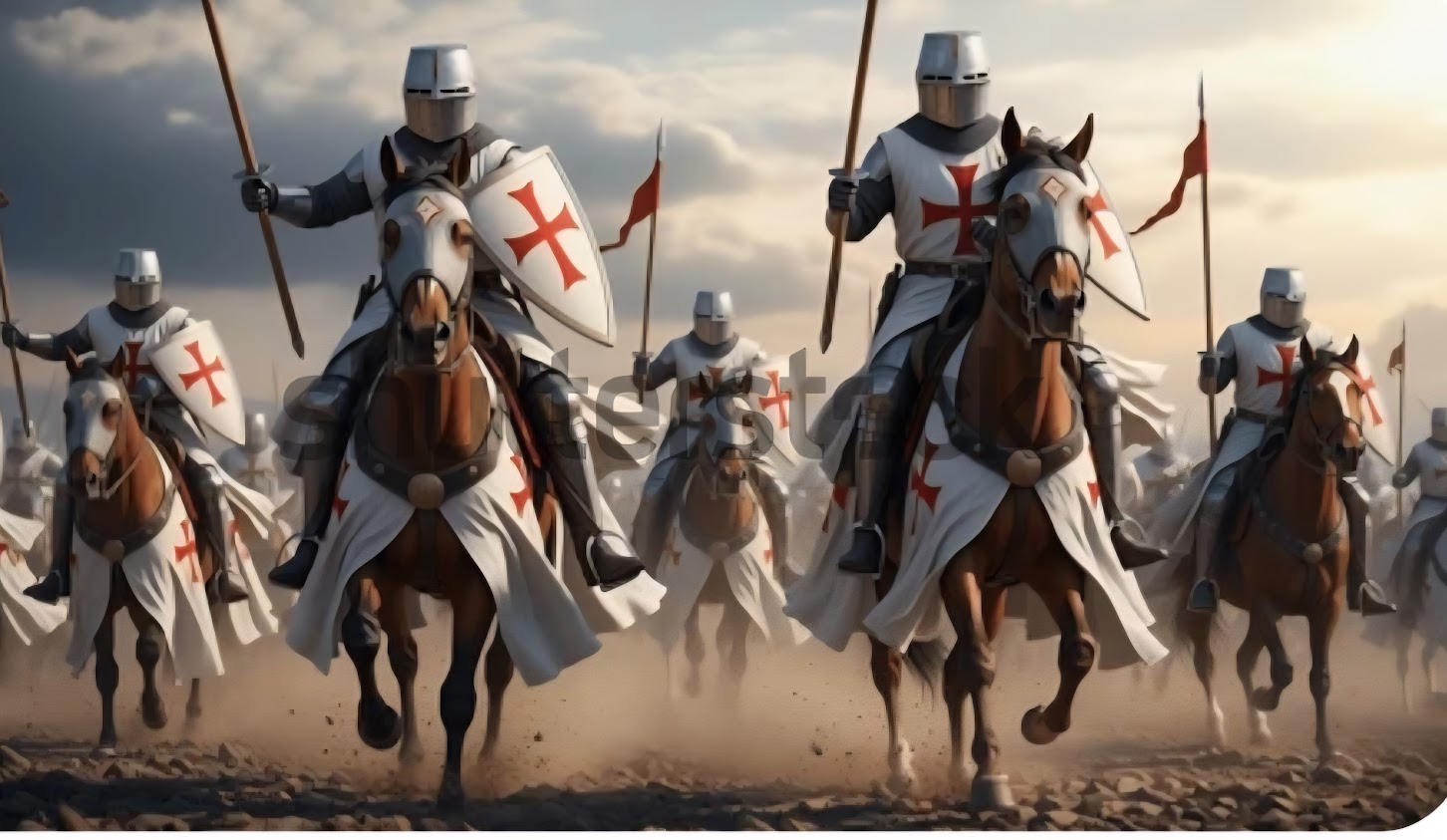
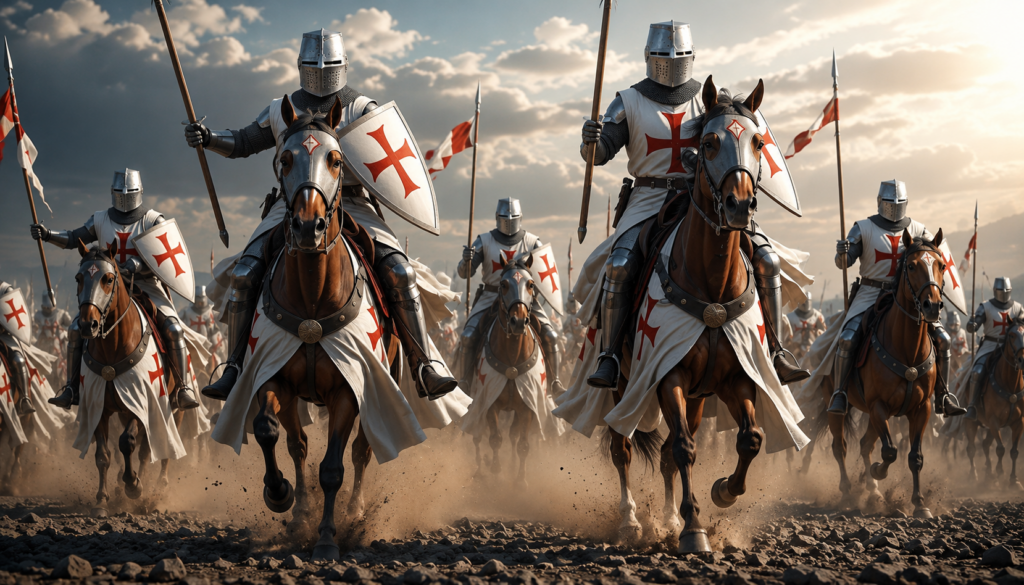
    By the early 1000s, a quiet transformation had taken place. The knight was no longer just a fighter. He was becoming a Miles Christi—a Soldier of Christ. Not formally. Not yet. But the idea was there:

    • Fight for the Church
    • Defend the weak
    • Serve a higher cause

    And most importantly…Do it in God’s name.


    Then Came the Crusade

    When the First Crusade was called in 1095, the groundwork had already been laid. Thousands of knights answered the call. Not because it was new. But because it felt familiar. They had already begun to see themselves this way. The crusade didn’t create the Miles Christi. It unleashed it.


    The Templars: Not the Beginning

    A generation later, the Knights Templar were formed. For the first time, the idea became an institution:

    • Monks who fought
    • Warriors who prayed
    • Soldiers who served Christ directly

    It looked revolutionary. But it wasn’t. It was the final step in a transformation that had been building for over a century.


    The Truth Behind the Legend

    The Templars didn’t invent the holy warrior. They inherited him.

    Forged in chaos.
    Shaped by the Church.
    Proven in places like Provence.

    Long before Jerusalem… The first Soldiers of Christ were already walking the earth.

    Our next investigative article is: Oligamus Stella” Reconsidered: Mis-Segmentation Scribal Error, and the Creation of a Phantom Historical Figure, to read this article,please us our Directory Portal.

  • Before the Templars: How Chaos Created the First Soldiers of Christ

    To view our all of our investigative articles please use the discovery portal.

    The full length academic version of this article is available @ Zenodo.org

    Author: Douglas Estill

    The Neapolis Forgotten Paths Project (2026)

    Part I of the Before the Templars Series

    Abstract

    This study examines the emergence of armed Christian defenders in early medieval Europe prior to the formal establishment of military religious orders such as the Knights Templar. Focusing on the instability of the 9th–10th centuries—particularly in regions such as Provence—this paper argues that the concept of the Miles Christi (Soldier of Christ) arose not as a sudden ideological innovation, but as a practical response to sustained political fragmentation, external threat, and the failure of traditional protective structures. The conditions that produced these early warrior communities demonstrate that the foundations of sacred warfare were established well before their institutionalization in the Crusader period.

    I. Introduction: A World Without Protection

    The emergence of the Knights Templar in the early 12th century is often presented as a turning point in the relationship between warfare and Christian piety. Yet this narrative obscures a deeper question:

    What conditions made such an institution possible in the first place?

    To answer this, one must look not to the moment of formal foundation, but to the centuries of instability that preceded it. In the 9th and 10th centuries, large portions of Western Europe experienced a breakdown in centralized authority, leaving local populations exposed to sustained external and internal threats.

    In this environment, the distinction between lay defender and religious actor began to blur, giving rise to a new form of identity: the armed Christian operating in defense of both land and people.

    II. The Collapse of Order

    Following the fragmentation of Carolingian authority, the political landscape of Western Europe became increasingly localized. Power shifted from centralized rulers to regional elites, while the capacity for coordinated defense diminished.

    This fragmentation produced:

    • Weakening of royal military response
    • Increased reliance on local fortifications
    • Vulnerability of rural and monastic communities

    The result was not simply political decentralization, but a crisis of protection. Communities that had previously depended on structured authority now faced threats with limited institutional support.

    III. External Pressure and Persistent Threat

    Among the most significant destabilizing forces in southern Europe was the presence of raiding groups operating from strongholds along the Mediterranean coast.

    One such center was Fraxinetum, which functioned as a base for incursions into the Provençal interior. From this position, raiders were able to:

    • Disrupt inland trade routes
    • Target ecclesiastical centers
    • Maintain prolonged regional instability

    The persistence of such threats transformed insecurity from a temporary condition into a structural reality.

    IV. The Failure of Traditional Structures

    Ecclesiastical institutions, while influential, were not designed to provide military defense. Monasteries, churches, and clerical estates often found themselves:

    • Isolated
    • Under-defended
    • Dependent on external protection that no longer reliably existed

    At the same time, local elites lacked the resources or coordination to maintain continuous defense across large territories.

    This created a gap between moral authority and physical protection.

    V. The Emergence of Armed Piety

    It is within this gap that the earliest forms of armed religious identity began to emerge.

    Individuals and groups—often operating locally—began to assume roles that combined:

    • Martial capability
    • Religious justification
    • Territorial defense

    While not yet formalized, these actors represented an early convergence of two previously distinct spheres: warfare and devotion.

    The conceptual foundation for the Miles Christi—the Soldier of Christ—was not imposed from above, but developed organically in response to necessity.

    VI. Provence, France as a Case Study

    The region of Provence offers a particularly clear example of these dynamics.

    Centered around routes linking Marseille to inland settlements such as Draguignan, the area functioned as both a corridor of movement and a zone of vulnerability.

    Key features included:

    • Exposure to coastal incursions
    • Limited centralized defense
    • Strategic terrain requiring localized control

    These conditions made Provence not only a site of conflict, but a laboratory for the development of new defensive responses.

    VII. Toward the Soldier of Christ

    The phrase Miles Christi originally functioned as a metaphor within Christian literature, describing spiritual struggle rather than physical combat. However, under the pressures described above, this metaphor began to take on a more literal dimension.

    The transformation involved:

    • Justification of armed defense in religious terms
    • Integration of martial identity with spiritual purpose
    • Increasing acceptance of violence under specific conditions

    This shift did not yet produce formal orders, but it established the ideological groundwork upon which such institutions would later be built.

    VIII. Conclusion: Chaos as Catalyst

    The emergence of the first “Soldiers of Christ” was not the result of a single event or decree. It was the outcome of prolonged instability, geographic vulnerability, and institutional limitation.

    What later appeared as organized religious warfare had its origins in a far less structured reality:

    A world in which communities could no longer rely on protection—and in which new forms of identity arose to fill that void.

    The Knights Templar did not invent the concept of sacred warfare. They inherited and formalized it.

    Our next investigative article is: The Rise of the Miles Christi (c. 900-1100), to continue reading, please use our Directory Portal.

  • Where Is Stella – Tracing The Ground Behind A Medieval Misreading

    To view all of our investigative articles, please visit our directory

    For the full academic paper visit Zenodo.org

    Author: Douglas Estill

    The Neapolis Forgotten Paths Project (2026)

    In part one, we questioned whether “Oligam Stella” ever existed.

    In part two, we showed how a Latin phrase may have been misread into a name.

    In part three, we investigate not only importance of the Stella Corridor, but the people and their roles in the the land?


    Tracing The Ground Behind A Medieval Misreading

    When the Pieces Finally Started to Look Familiar

    By the time I had worked through the problem of “Oligamus Stella” and walked the terrain around the Stella Corridor, Draguignan and Les Arcs-sur-Argens; something started to feel… familiar. Not in a modern sense—but historically familiar. There was: a controlled landscape, a defined movement corridor, a church sitting at a strategic point, and a group of armed men being called together. And at some point I caught myself thinking: This looks a lot like something I’ve seen before. Just not yet… fully formed.


    The Scene in the Charter:

    Let’s go back to the moment that all of this started. The text describes: a dispute; monks involved; a layman (Poncius); and an escalation to authority. And then this: Local milites(knights) are summoned and they assemble inside a church(Saint -Christopher). Among them is: Malfredum de Stella, Flota de Stella and other milites. Now that’s important, because this is not: a battlefield; not a siege; not a military campaign. This is: armed men gathering under church authority to resolve a conflict!!!


    Who Were These “Milites(Knights)”?

    It’s easy to read the word milites and imagine something like crusaders. But that’s not what we’re looking at here. In this context, milites were: local mounted retainers; tied to land; tied to obligation; tied to regional church authority. They weren’t a standing army. They were something more fluid: They were men who could become a force when needed.


    The Landscape They Operated In

    Once you place them on the ground, everything sharpens. You’ve got: the ridge at Le Malmont; the mid-slope platform at Le Rastéou; and the funnel at the Argens River. This isn’t random geography. It’s a corridor(The Stella Corridor) where: movement is controlled; routes converge; and decisions matter. If you lived here, you didn’t just pass through this landscape. You operated within it.


    Why the Church Matter

    The charter doesn’t just say the men gathered. It says they gathered: inside a church — Sancti Christophori. That detail changes everything, because it tells us: this is not just military; this is not just legal; this is both. The church is acting as: a place of authority;
    a place of oath; and a place where violence is restrained. In other words: a controlled environment for men who are capable of violence.

    Remember in the previous article where the Archbishop of Arles was called upon to settle a dispute and he summoned and compelled local authorities(knights) to appear at the Saint-Christhopori church. And the men that he called were Flota de Stella, Malfredum de Stella, and other milites.

    A System Starts to Emerge

    At this point, the pieces stop feeling isolated. They start to connect. You have: a movement corridor (Argens valley); a convergence node (near Les Arcs); a gathering platform (Rastéou); a watching height (Malmont); and a church(Saint-Christophori) anchoring it all. And moving through that system are: landholders; knights; and representatives of the church. This isn’t just a place. It’s a structure.

    And Then the Thought Hits:

    Somewhere in the middle of laying this out, the comparison becomes unavoidable: This looks like an early version of something much more familiar. Because later in history, we see groups that: operate along routes; protect travelers; align closely with the church; and maintain armed presence.


    We call them: The Templars or Knights of the Templar

    But This Isn’t That -Not yet. There’s no: formal order; centralized rule; and institutional identity. What you’re looking at here is earlier: more loose and local. But the behavior…the behavior is strikingly similar: church alignment; armed presence; protection function.


    A Proto-Templar Pattern vs A Templar Pattern Comparison

    Both feature the Stella Corridor; both exhibit route awareness; both feature church alignment; both feature an armed presence;
    both provide a protection function; while the Proto Templars do not exhibit a formal organization, the Knights Templar do exhibit a formal organization. The organization into a formal military unit would not occur for about another 100 years. What we’re seeing in the Stella Corridor is not the Templars. but it is something that makes sense as a precursor.


    Where Malfredum Fits In

    This brings us back to: Malfredum de Stella. He is: not mythical; not invented; and not floating in abstraction. He is tied to: a place; a system; a role within that system. And that matters more than any invented founder ever could. Because he represents: a real person operating inside a real structure.


    What This Actually Was

    By now, the picture is clear enough to describe. This was: a localized network of armed landholders; operating within a defined movement corridor; under the influence of church authority; capable of assembling quickly; and resolving disputes before they escalated into violence. Not a military order-not yet. But not random either.


    The Bigger Realization

    Once you see it, it changes how you read the earlier material. The story isn’t: A lost founder or a missing genealogy It’s this: A real system existed… and we almost missed it because we were looking for a name instead of a pattern.


    Closing Thought

    The Templars didn’t appear out of nowhere. They emerged into a world where: routes needed protection; church authority needed enforcement; and armed men already operated alongside the church. What we’re seeing in the Stella corridor is a glimpse of that world before it was formalized. And once you recognize it, the landscape doesn’t look quiet anymore; it looks organized.


    Where This Leaves Us

    We started with: a name that wasn’t real; and then we moved to a place that is very much real; and now we’re looking at a group of people operating within the system. Not myth. Not legend. But structure, The “Miles Christi”. From about (c. 1000-1118), they were responsible for protecting the church and it’s properties, the landowners and their properties, and the safety of travelers. They were the Proto-Templars.

    It took almost one hundred years before the Knights Templar would be formed into a structured organization. They were founded in Jerusalem around 1118, a French knight by the name of Hugues de Payens along with 8 others united to protect pilgrims traveling from the coast to the Holy City. The Knights Templar were officially recognized by the church in 1129.


    To continue to our next investigative article: Before the Templars: How Chaos Created the First Soldiers of Christ, please use our Discovery Portal.